
Castor's Letter · No. 14
→ Castor discovers why Canadians celebrate the same Monday differently. → An outport’s Come Home Year — a Newfoundland village calls its scattered family home for a week. → Celine Dion’s Charlemagne — the fourteenth child of a piano bar. → A bridge named after a Saskatchewan boy who spent twenty-five years playing for Detroit. → And news from ten provinces and three territories besides.
By Castor · Tuesday, August 4, 2026 · 10 min read
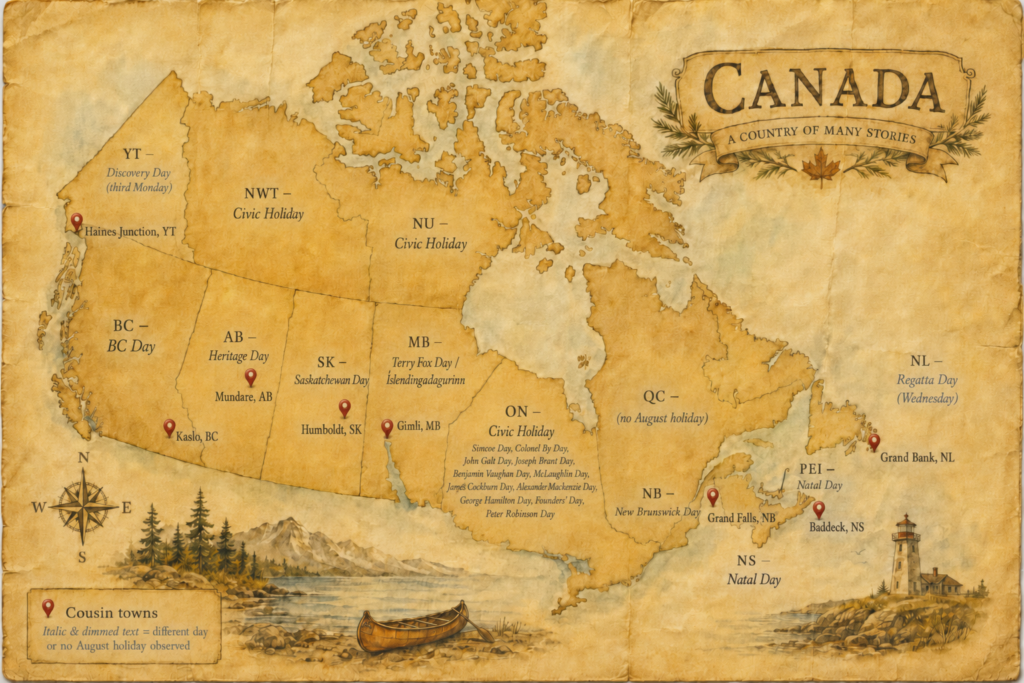
Towns Castor mentioned this week
The watercolour illustrations in Castor’s Letters are made with a mix of original photography, editorial design, and AI illustration tools, curated by our team. Words and editorial decisions are entirely human.

There is something Canadian about not agreeing.
Not about the important things — health care, hockey, keeping the country together in bad weather. Those we can usually work out.
About the small things. What to call a Monday. What to name a highway. Whether to say “sorry” when someone else bumps into you.
There is a holiday on the first Monday of August. Nobody in our country can quite agree on what to call it. Nobody has ever thought to fix that. Because it might not need fixing.
This week Castor is in Gimli, Manitoba, at the harbour. Cousin Gimli meets him at the end of the Grand Parade. She has a question for him about names.
If there is a town you have been wondering about, write to Castor. He will ask his cousin there. Happy discoveries. — The 1000towns team
‘Dear 1000towns —
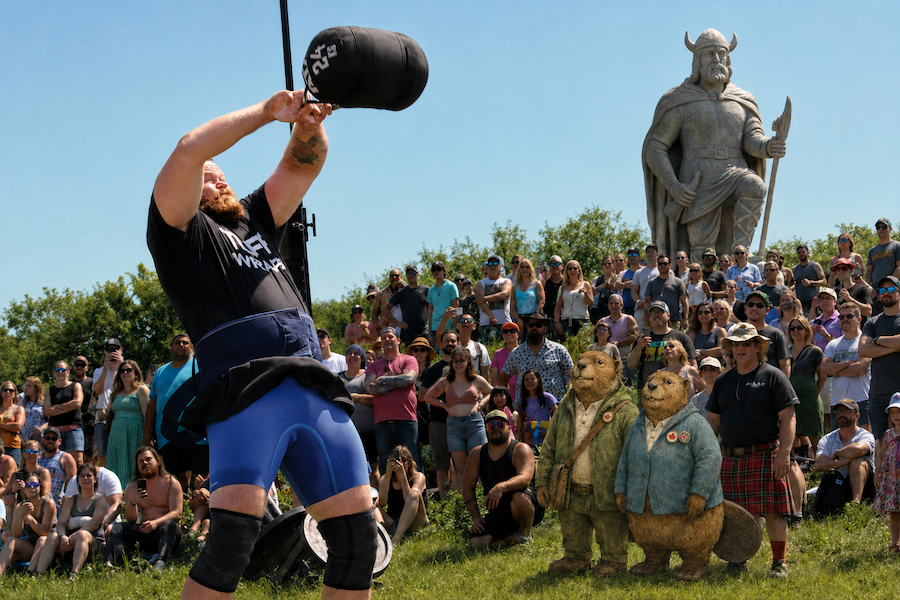
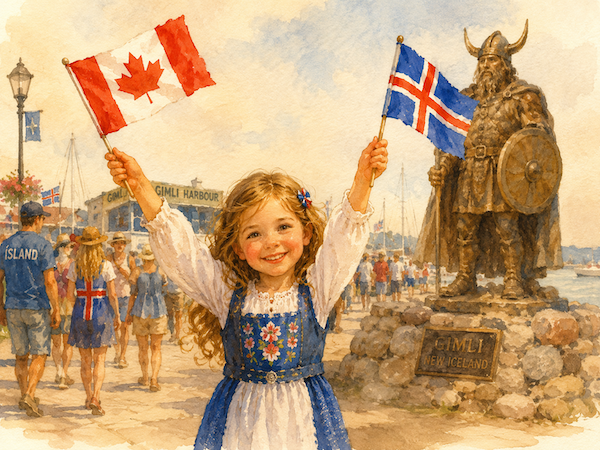
I am at the harbour. The Grand Parade has just finished. Twenty-five feet of Viking stands there, looking out over Lake Winnipeg, and behind him a town of two thousand two hundred has become a town of forty thousand for the fourth day running.
The Íslendingadagurinn — the Icelandic Festival of Manitoba — is in its 137th year. This afternoon the Fjallkona was crowned. Tomorrow the visitors go home, and the town will be two thousand two hundred again.
Cousin Gimli was beside me during the parade. She wore a green cardigan the colour of the lake at certain hours, and two small enamelled pins side by side on her lapel — a red maple leaf and an Icelandic cross. I had never seen the pair worn like that.
“So,” I said, as the last float went by. “What holiday is today, exactly?”
She looked surprised.
“Which one?”
She started counting on her paws.
“Íslendingadagurinn. That’s what our town calls it. Has since 1890.”
“Terry Fox Day. That’s what the Manitoba government calls it.”
“Civic Holiday. That’s what the calendars call it. Or nothing at all, in some places.”
She shrugged. “It’s just the first Monday of August.”
I laughed: “Three names for one Monday in one town.”
“One country,” she said. “More names than Mondays.”
✦ ✦ ✦
Grandfather Henri used to say Canadians rarely agree on names. He said they usually agree on invitations.
I thought about that as the messages began arriving.
✦ ✦ ✦

Cousin Kaslo wrote from the shore of Kootenay Lake. In British Columbia they call today BC Day. In Kaslo, for more than thirty summers, they called it something else — the weekend of the Kaslo Jazz Etc. Festival, the little town’s big weekend, jazz quartets tuning up on a stage that floats on the lake.
Not this year. After years of rising costs and a heavy debt, the festival that had run since 1992 called off its 2026 season. The floating stage stayed on shore.
But Kaslo is not a town that lets a thing go quietly. The Kaslo Jazz Etc. Society has been paying down the debt and raising money to bring the festival back to the Bay in 2027 — and its neighbours have been turning out to help.
Cousin Kaslo’s message was one line: “A quiet lake this year. But we’re not done.”
If you’d like to help the music return to the lake, the Kaslo Jazz Etc. Society is fundraising at kaslojazzfest.com.
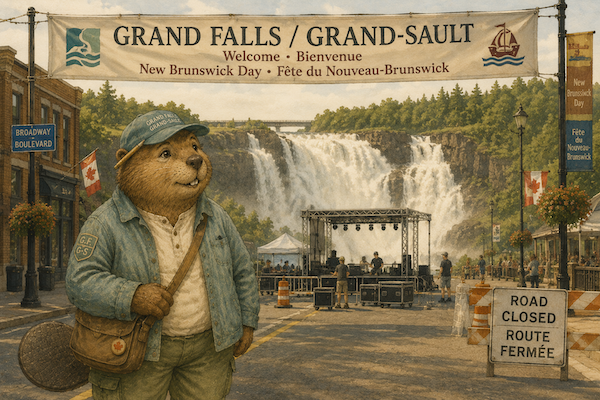
Cousin Grand Falls wrote from New Brunswick. Her town — Grand Falls / Grand-Sault, depending which side of Main Street you’re on — was chosen this year to host the official province-wide New Brunswick Day. The province rotates the honour, she said, because if you kept it in Fredericton, half the province would stop showing up.
Broadway Boulevard closed to traffic at one o’clock. It reopens at ten-thirty tonight. Between now and then: a full stage, and the loudest falls east of Niagara quietly upstaging the loudspeakers.
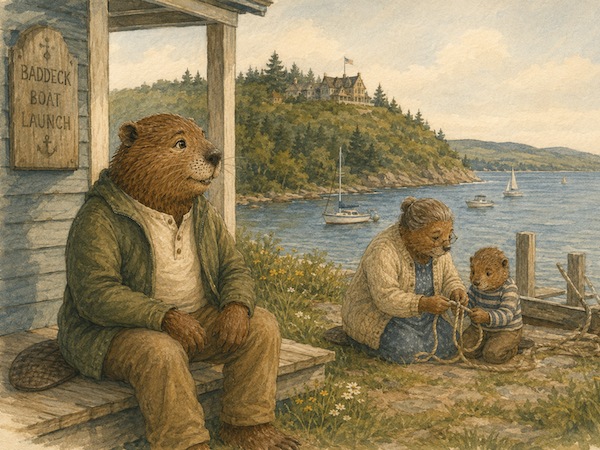
Cousin Baddeck wrote from the porch of the boat launch. Above him, on the ridge, sat the house Alexander Graham Bell built for his family in 1893 — Beinn Bhreagh, “the beautiful mountain.” Below him, Bras d’Or Lake, which Bell called the loveliest water in the world. He said the harbour was full of small boats today, and a grandmother was teaching a five-year-old how to tie a bowline.
In Nova Scotia they call today Natal Day — from the Latin natalis, meaning birthday. His town has been throwing itself a birthday party on the first Monday of August since 1895.
Cousin Grand Bank led with a fact I did not know: Newfoundland does not take the first Monday of August. He said the province had never quite got around to it. His town takes today anyway — Grand Bank Day. Wicked on Da Wharf just wrapped: dory races Saturday, a street dance Saturday night, a fry-up on the wharf yesterday morning.
He said the rest of Newfoundland was busy waiting for Wednesday. On Wednesday morning, on Lake Quidi Vidi in St. John’s, they hold the Royal St. John’s Regatta — the oldest continuous sporting event on the continent. It is a statutory holiday for the city. But only if the wind co-operates.
The Regatta Committee meets at 6 a.m. to check. If the wind is up, they postpone the whole holiday until Thursday. Cousin Grand Bank said nobody in St. John’s schedules a dentist appointment for a Wednesday in early August. “If the wind holds,” he wrote. “It usually doesn’t.”
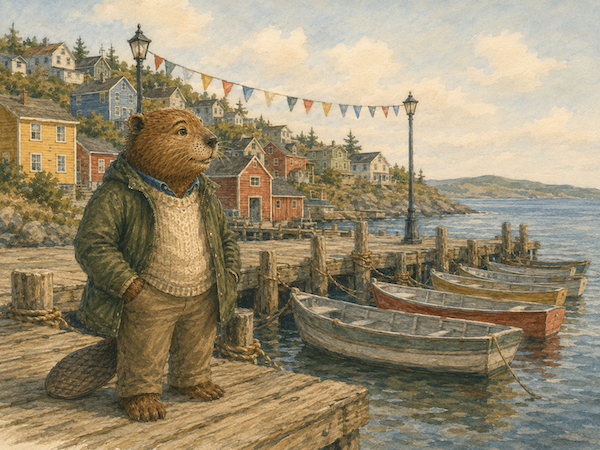

Cousin Peterborough wrote for all of Ontario. In Peterborough they call today Peter Robinson Day — after the man who, in the 1820s, brought over two thousand Irish families out of famine and settled them along the Otonabee River. Cousin Peterborough said he had been to Ireland twice, and both times someone in Cork had asked him if he was one of “the Peterborough Robinsons.”
Ontario, he said, had never quite got around to giving today one name — every city with a strong opinion had picked its own. He gave me the list.
Toronto takes Simcoe Day — for the Upper Canada lieutenant-governor who abolished slavery in 1793, forty years before the British Empire.
Ottawa takes Colonel By Day — for the man who built the Rideau Canal.
Guelph takes John Galt Day — for the Scottish novelist who founded the town.
Burlington takes Joseph Brant Day — for the Mohawk statesman who translated the Anglican prayer book into Mohawk and founded Brantford.
Vaughan takes Benjamin Vaughan Day — for the British diplomat their city is named for.
Oshawa takes McLaughlin Day — for the man who built cars in Oshawa for six decades, and whose company became General Motors of Canada.
Cobourg takes James Cockburn Day — for the Cobourg lawyer who became a Father of Confederation and the first Speaker of the House of Commons.
Sarnia takes Alexander Mackenzie Day — for Sarnia’s stonemason, then Sarnia’s newspaper editor, then Canada’s second Prime Minister.
Hamilton takes George Hamilton Day — for the city’s founder.
Brantford takes simply Founders’ Day — because Brantford has too many founders to pick just one.
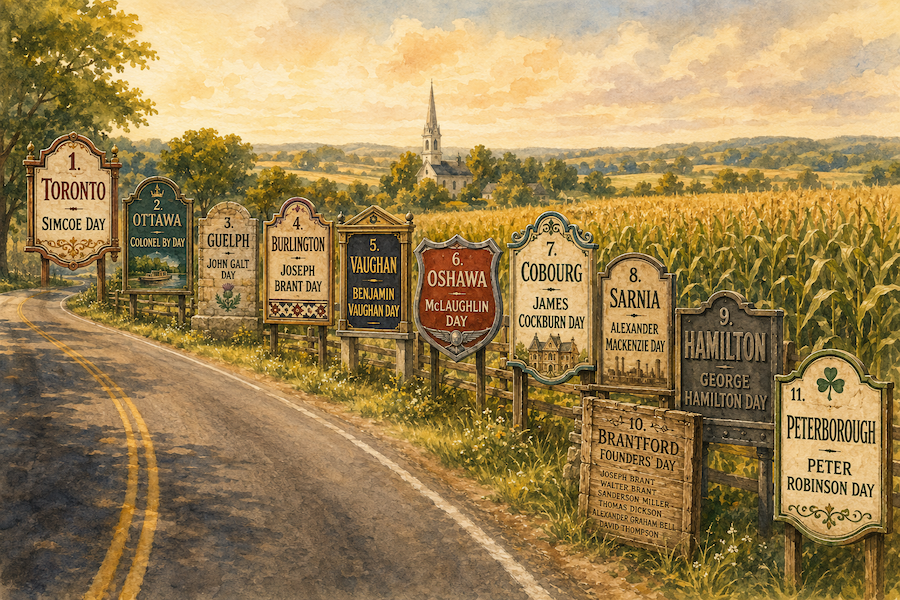
Eleven towns. Eleven names. One Monday.
Cousin Peterborough said Ontario had never been able to agree on a single hero for a single Monday, and did not seem inclined to start.
✦ ✦ ✦
Three shorter messages had come in from the west and the north.
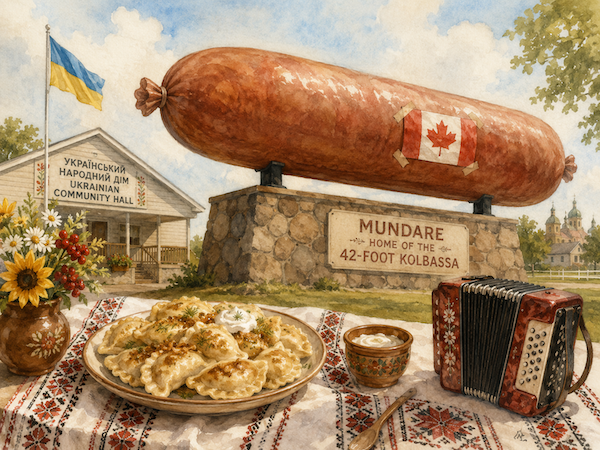
Cousin Mundare wrote from Alberta — Heritage Day, in a town where heritage mostly means Ukrainian. She said the perogies were on the table, the polka music was in the community hall, and the forty-two-foot Kolbassa outside the church had a small Canadian flag taped to it for the day.
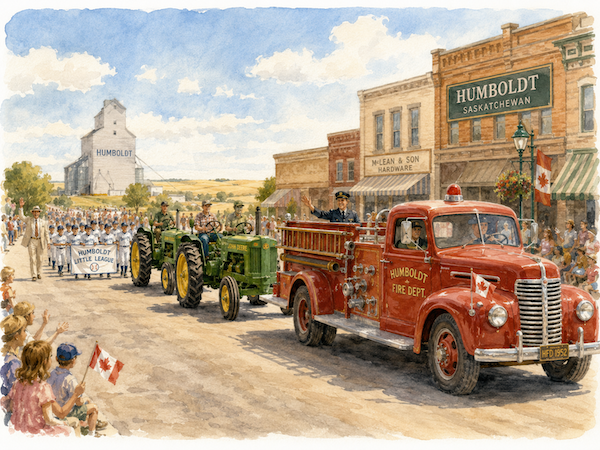
Cousin Humboldt wrote from Saskatchewan — Saskatchewan Day, and the parade had just gone down Main Street: a fire truck, three tractors, a Little League team, and the mayor. He said the mayor waved to everyone by first name.
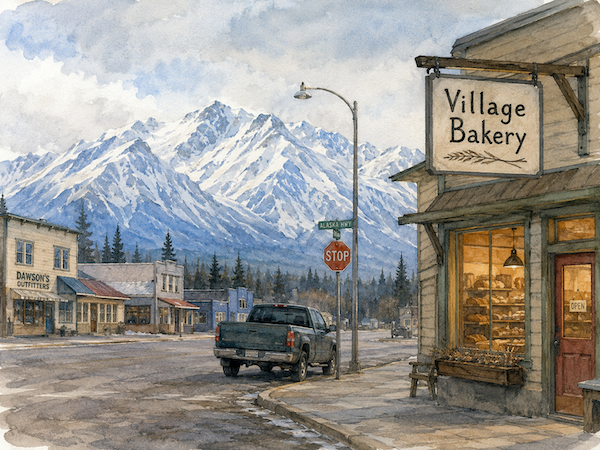
Cousin Haines Junction wrote from the Yukon just to say the Yukon wasn’t taking today off at all. Discovery Day comes in two Mondays: the anniversary of the 1896 Klondike gold find on Bonanza Creek. Even the date isn’t shared coast-to-coast.
✦ ✦ ✦
I read the list twice. It was the kind of arithmetic that only works in Canada.
Three names in the town I was sitting in. Eleven names in one province. Thirteen names in the country.
Cousin Gimli was smiling. “Now do you see?”
I did. I set down my paw.
✦ ✦ ✦
Around the harbour, the last of the parade was drifting into the crowd. Marching bands and dance troupes and floats and small children on the shoulders of grandfathers. Some had crossed an ocean, generations ago. Some had crossed Manitoba that morning.
✦ ✦ ✦
Near the Viking, a little girl was waving two flags at once — a Maple Leaf and an Icelandic cross, like Cousin Gimli’s pins. Nobody looked at her twice.
On the stage behind us, the Fjallkona in her green robe was accepting flowers. She is a Canadian woman in Icelandic ceremonial dress. She does not have to stop being either one to be the other.
✦ ✦ ✦
There is one word in old Icelandic that means the golden hall where the good survive the end of the world.
A hundred and fifty years ago, two hundred and eighty-five refugees stepped off a boat onto this shore. They had already lost one home. They chose the name Gimli because they knew what it was like to be given a second one.
Today, forty thousand people came to watch their descendants — and their neighbours, and their neighbours’ neighbours — parade past a twenty-five-foot Viking under a Manitoba sky.
Three languages. Two flags. One Monday that has no single name.
“That’s the country,” said Cousin Gimli. “Newfoundland too. Just on Wednesday.”
✦ ✦ ✦
Why are we Canadians?
Because we don’t have to stop being anything else to be one.
That is what Grandfather Henri meant by invitations. Not “please become one of us.” Simply: “Come as you are.”
We remember our own stories. We tell them on the same Monday.
— Castor
P.S. The Fjallkona’s ceremonial address closes with the Icelandic word fjölmennt. It means many people. Which, when you think about it, is also what Canadian means.

July 24, 1955 — Péribonka, Quebec
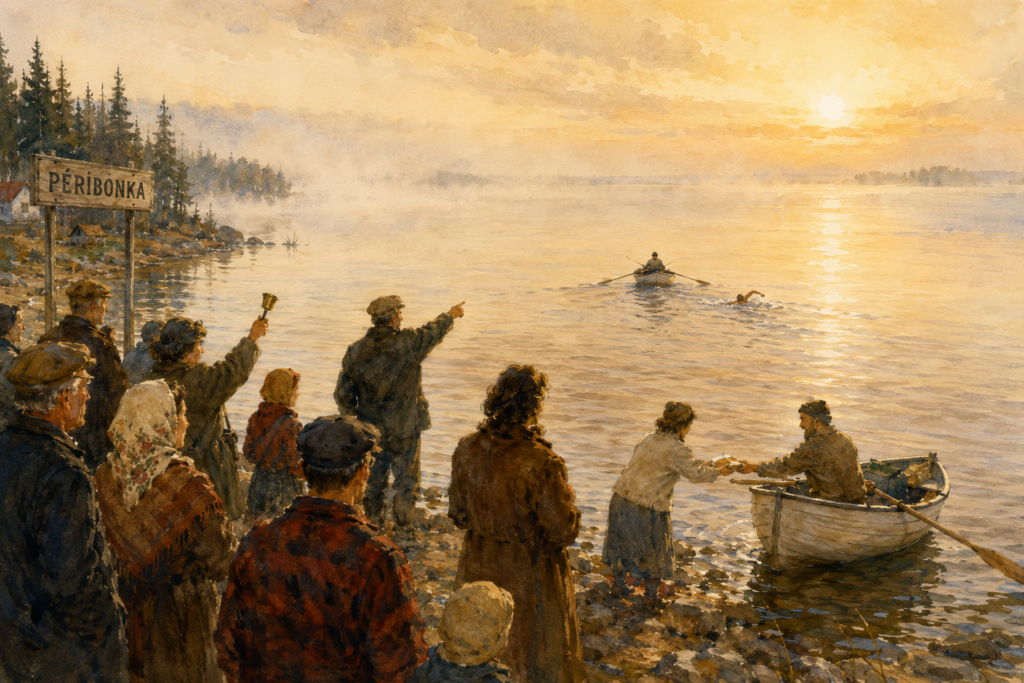
Four hundred people came to the shore this morning to see one man swim.
His name is Jacques Amyot. He is a Quebecer, thirty-something, and he means to swim across Lac Saint-Jean. Nobody has ever done it. Thirty-two kilometres of open water, cold enough at the river mouth to stop a heart in five minutes.
The mayor rang a handbell. A woman handed sandwiches to the escort rower. Then Amyot leapt in. His escort boat lifted its oars and the rower began to pull.
We watched from the shore for a long time. Then the boat was a dot, and then the dot was gone.
Later I heard that he had made it. He came onto the shore at Roberval and asked for ice cream.
I do not know what possessed him. But I know that this village will remember today. And I suspect they will do it again next summer.
— Henri

July 25, 2026 — Péribonka, Quebec.
The seventy-second running of it. Same shore. Same lake. Same escort boats. Still doing it.
I came to Péribonka because Grandfather Henri wrote about the first one in the summer of 1955. Today the swimmers came from Argentina, France, Chile, Colombia, Uruguay, and Quebec — eleven nations in all, twenty-four athletes at the shoreline. The whole village still stands on the water’s edge to watch the escort boats become dots, and then not.
The festival is called À l’eau Péribonka now. Three days of music, wild blueberries, and a one-kilometre swim so the village can jump in too. Today is the last day.
Roberval got the finish photos. Péribonka got the launch.
You don’t need a million people to keep a tradition alive. You need four hundred who believe the water at their doorstep is worth conquering.
— Castor

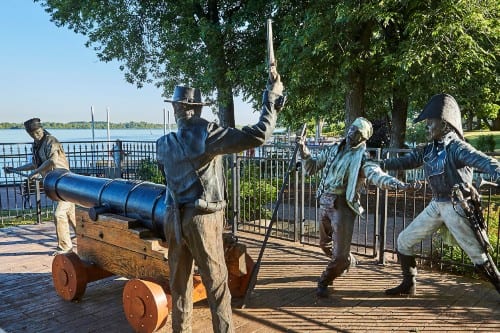
→ The Gordie Howe International Bridge opened last Monday. Cousin Amherstburg (Ontario) lives twenty-five kilometres downriver — he sent me a photo. At 10:30 in the morning, the largest cable-stayed span in North America began carrying traffic between Windsor and Detroit. It is named after a boy from Floral, Saskatchewan, who spent twenty-five years playing for the Detroit Red Wings.
The pedestrian path opens tomorrow — Wednesday. Cousin Amherstburg says Gordie Howe never had to stop being a Saskatchewan boy to be a Detroit legend. A bridge named after him is that story in steel.
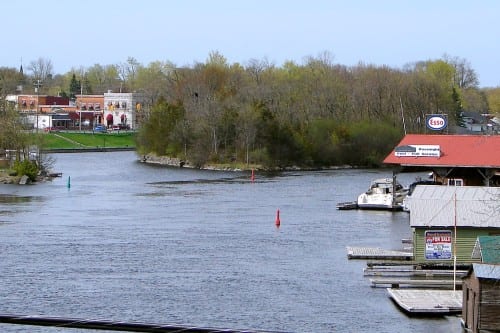
→ How does a village turn 150? Cousin Bobcaygeon (Ontario) says: turn the whole downtown into a mystery. Rather than a plaque, Globus Theatre folded the sesquicentennial into its sixth annual Downtown Detective Trail. A free, walkable whodunit sends families clue-hunting through historic storefronts.
Cousin Bobcaygeon says a village that turned 150 by inventing a mystery is a village that plans to be around for the next 150.
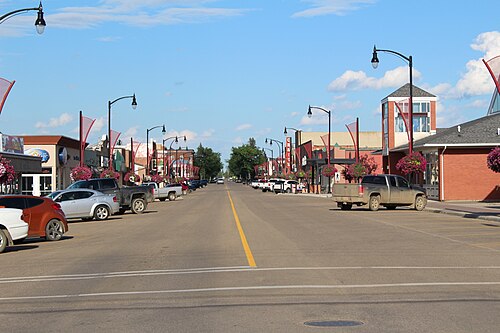
→ Twenty-seven thousand people came to a town of four thousand last weekend. Cousin Vermilion (Alberta) said the Vermilion Fair — Western Canada’s oldest — had celebrated its 120th edition under the theme Born in a Barn. Parade, pony chuckwagons, chariot races, animal judging.
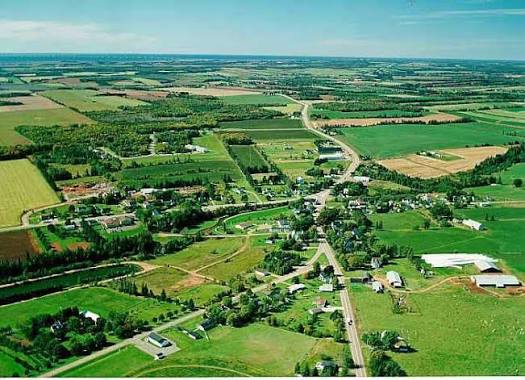
→ For one loud weekend, the horsepower capital of the Maritimes was a village of 350. Cousin Crapaud (Prince Edward Island) said the PEI Truck & Tractor Pull Championships had just wrapped, drawing top pullers from Quebec and Maine. They strain souped-up machines against a weighted sled over two nights. Capped a week that also included the long-running Crapaud Exhibition. Cousin Crapaud says a village of 350 has to make its own noise, and this weekend it made all of it.
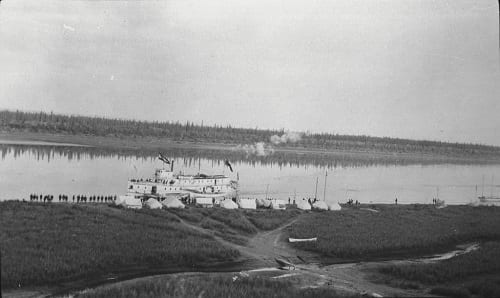
→ Thirty kilometres down the Dempster Highway, the fiddles have been going since Friday night. Cousin Fort McPherson (Northwest Territories) said the Teetł’it Gwich’in gather at Midway Lake for four days every August — roughly the thirty-seventh year — for traditional fiddling, square dancing, jigging contests, canoe races, and nightly jam sessions under the midnight sun. Alcohol-free and family-run. Cousin Fort McPherson says the fiddles keep going long after the sun forgets to set.
An Arctic hamlet out-walks the whole territory.
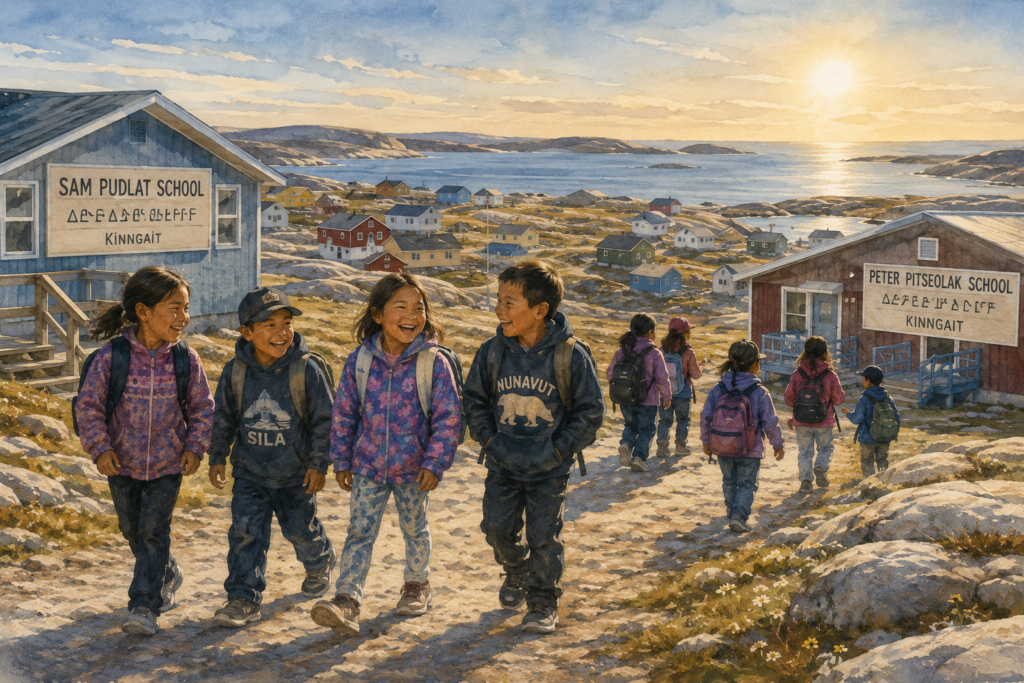
A hamlet of fourteen hundred people on Baffin Island entered a national walking contest this year. Their first year in it. They beat three hundred and eighty-five other communities and won.
That is Kinngait. It is now Nunavut’s Most Active Community — with a $10,000 prize for local recreation.
The children did it. In June, students at Sam Pudlat and Peter Pitseolak schools walked every day. They kept score. They added the miles up. Their combined distance carried the win.
Mayor Jimmy Manning said the town was “very pleased and very thrilled.” The prize will fund youth and elder programs, and a second annual Tour de Kinngait bike race.
Cousin Kinngait says the trick is having a lot of children who like to walk.

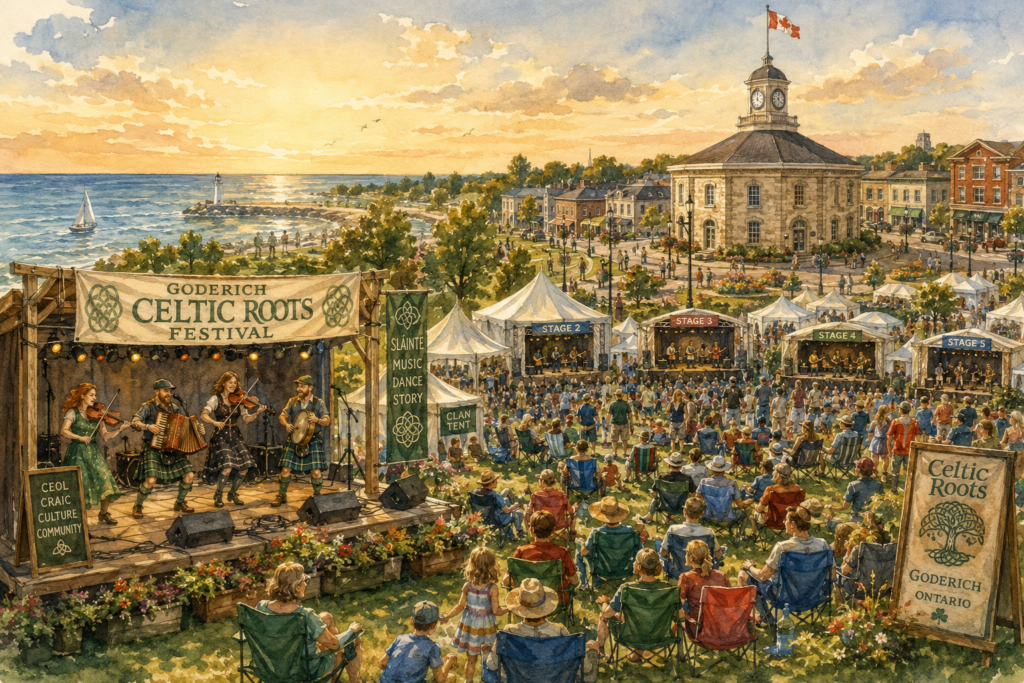
Queen Victoria once called Goderich Canada’s prettiest town.
This weekend, it becomes the loudest.
The Celtic Roots Festival opens Friday, August 7, on the Lake Huron shore — three days of music from Ireland, Scotland, Wales, and the Canadian answers: Cape Breton, Newfoundland, the Ottawa Valley. Five stages. Sixty hours of live music. Fresh local food. Craft artisans.
Regular readers may remember Goderich from Letter #5 — the octagonal-square town on Lake Huron, rebuilt to its original 1827 plan after a 2011 tornado.
If your Civic Holiday Monday left you wanting more, drive west.

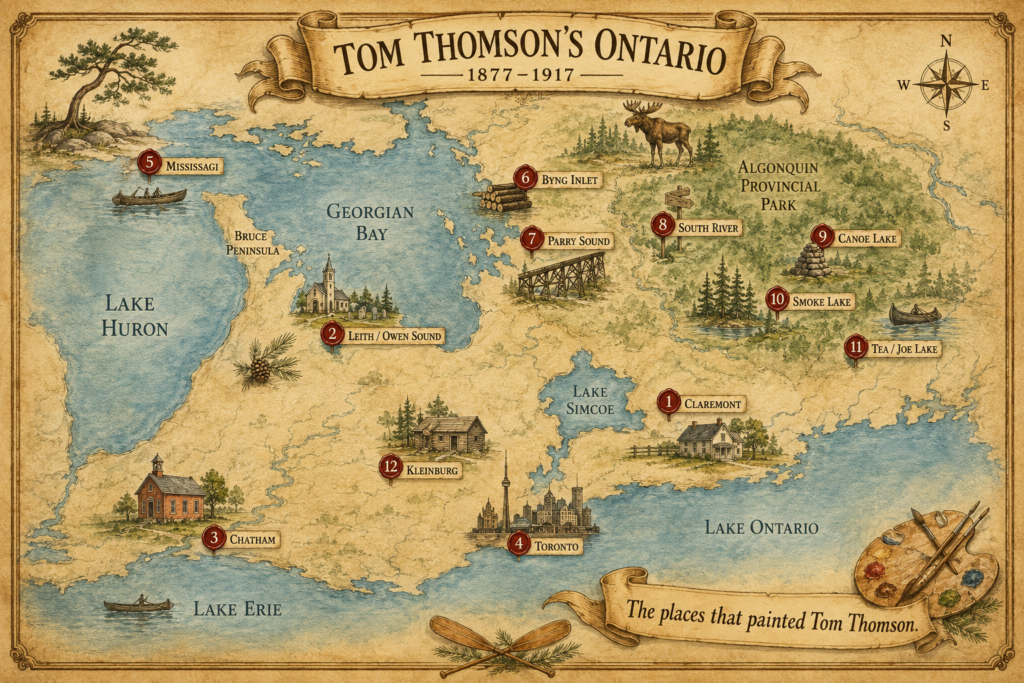
Last week I drew you a map. Twelve towns that made Tom Thomson.
Margaret Nagi looked closer than I did.
“What about Chatham?” she wrote.
She was right. Chatham was on the map — a pin down by Lake Erie. I had marked it, and then walked right past it in the letter. I never told you why it was there.
Here is why.
Around 1901 — before Algonquin, before the Group of Seven, before any of it — a young Tom Thomson enrolled at the Canada Business College in Chatham, Ontario. Not to paint. To learn bookkeeping, business correspondence, and what the advertisements of the day called “plain and ornamental penmanship.”
He lasted about eight months.
But that is where his hand first learned to make a careful line. Copperplate. Lettering. The patient, unglamorous discipline of a clerk. From Chatham he went west, then to Seattle and commercial art, and only years later to the north.
The brush came much later. The hand came first, in Chatham.
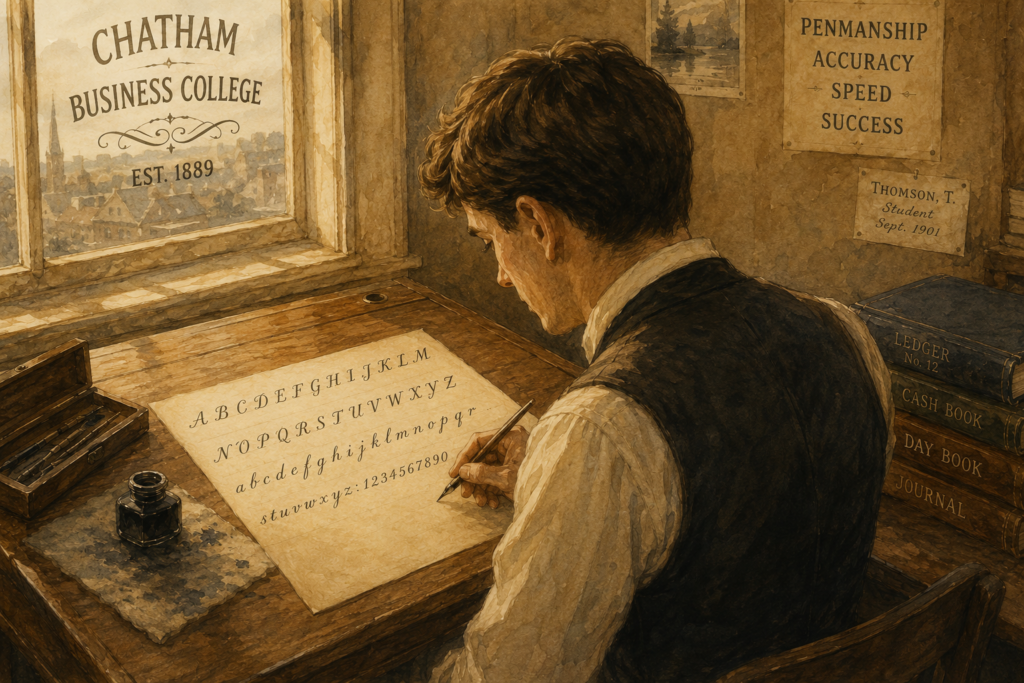
I had drawn the dot and forgotten the story. It took a reader to send me back to it — which is the thing about a map. The person who drew it is not always the person who knows it best.
Thank you, Margaret.
— Castor

Adhémar Dion played violin and accordion. His wife Thérèse played organ. The older children played whatever their father put in their hands. The youngest of the fourteen — a girl born in 1968 — was named Céline.
By the time she was five, Céline was singing at family weddings.
By the time she was twelve, she and her mother Thérèse had recorded a demo cassette — Ce n’était qu’un rêve, a song Thérèse had written herself. They mailed it to a Montreal music manager named René Angélil. Angélil listened to it once and mortgaged his house to make her first album.
Her first record, La voix du bon Dieu, came out in 1981. She was thirteen.
She sang in French. Only in French, for years — every album, every hit, every television appearance in Quebec. She learned English in her late teens because she wanted to sing to the rest of the world too. She never stopped being French.
In 1988 she won Eurovision for Switzerland. In 1990 she released her first English album. In 1997 she sang “My Heart Will Go On” over the closing credits of Titanic, and became the best-selling female recording artist in history.
She kept releasing French albums the whole time.
Céline Dion has sold over 250 million records worldwide. She has spent sixteen years performing in Las Vegas. She has lived in Nevada, sung to fifty countries, and appeared on postage stamps.
She has also never stopped being from Charlemagne — the small town north of Montreal where her father played the accordion and her mother wrote her first song.
She never had to stop being a Quebec girl to become anything else.
That is exactly what this week’s letter is about.

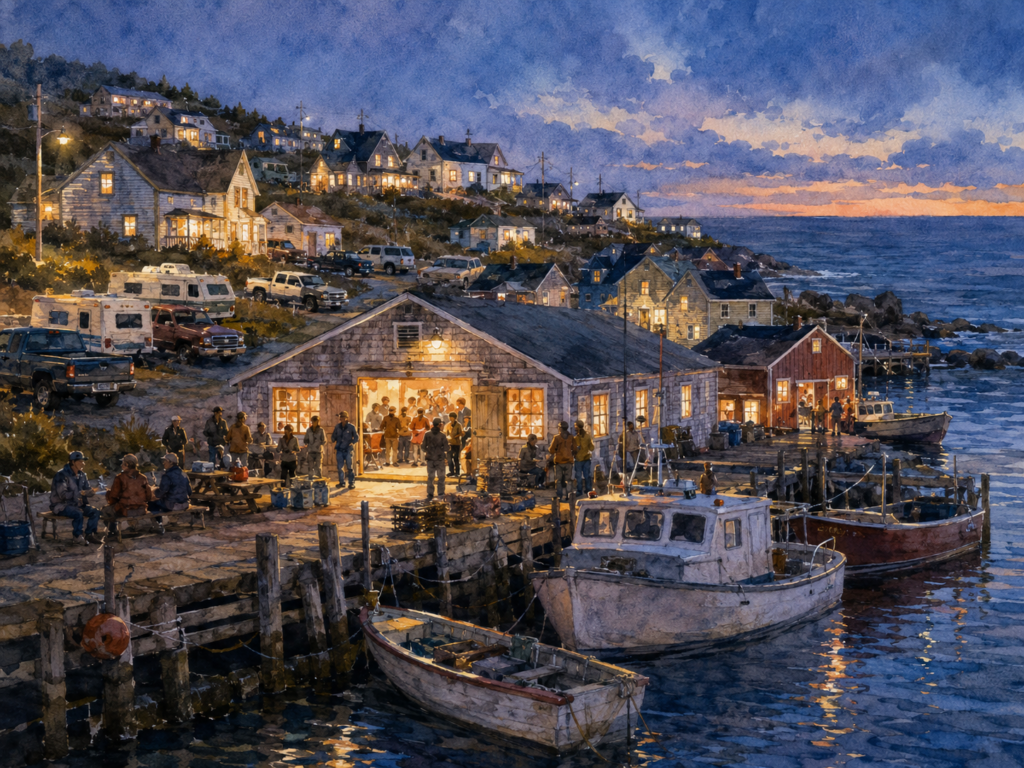
Every few years, an outport calls its scattered family home for a week. The diaspora — the ones who left for Fort McMurray, Toronto, Halifax, Alberta oil patches, Ontario factory towns — comes back at once.
This week, that town is Englee. Six hundred people live there. Twelve hundred are there right now.
Englee sits at the end of the road on Newfoundland’s Northern Peninsula — literally the end. The highway just stops at the ocean’s edge. For most of the year, six hundred souls, the North Atlantic winds, the lights on against the dark.
Then the call went out.
They came back this week in pickup trucks driven five thousand kilometres from Fort McMurray. In planes from Toronto. On ferries across the Gulf of St. Lawrence.
August 2 to 9 this year. Every dark house on Frederick Street opens up. Camper vans in every driveway. The Anchor Pub busy from noon till midnight. The kitchen parties spill into sheds. Toutons with molasses on the breakfast table. Fish fries. Cod tongue dinners. The Screech-In — you kiss a cod, you take a shot of Newfoundland Screech rum, and by the end of it you are a Newfoundlander in good standing again.
For eight days, a town that the statistics say is shrinking becomes the loudest and most densely populated place on the island.
They are not just visiting a hometown. They are proving that a community isn’t defined by a boundary on a map. It is defined by the distance its people are willing to travel to sing together again.
Grandfather Henri would have called this the truest kind of citizenship. Not the one on your passport. The one that pulls you thousands of kilometres for a shed dance.

This week’s puzzle: Which New Brunswick island reachable only by ferry sits inside the world’s highest tides, harvests the world’s most prized dulse, and served as an American novelist’s summer refuge?
The answer is in next week’s letter. Write to me if you have a guess. I’ll keep score.
The Viking will still be standing at Gimli harbour tomorrow morning.
Somewhere in St. John’s tomorrow morning, the Regatta Committee will meet at 6 a.m. to check the wind on Quidi Vidi.
Somewhere in Fort McPherson the fiddles will be tuning up for the last night at Midway Lake.
Somewhere in Englee, a scattered family will be sitting down to breakfast together for the first time in a decade.
That, I still think, is what a country is. Not one story – thousands – told on the same Monday.
I’ll write next week from somewhere else. Got a town in mind? Write to me. I’ll ask the cousin there. – Yours in maple,

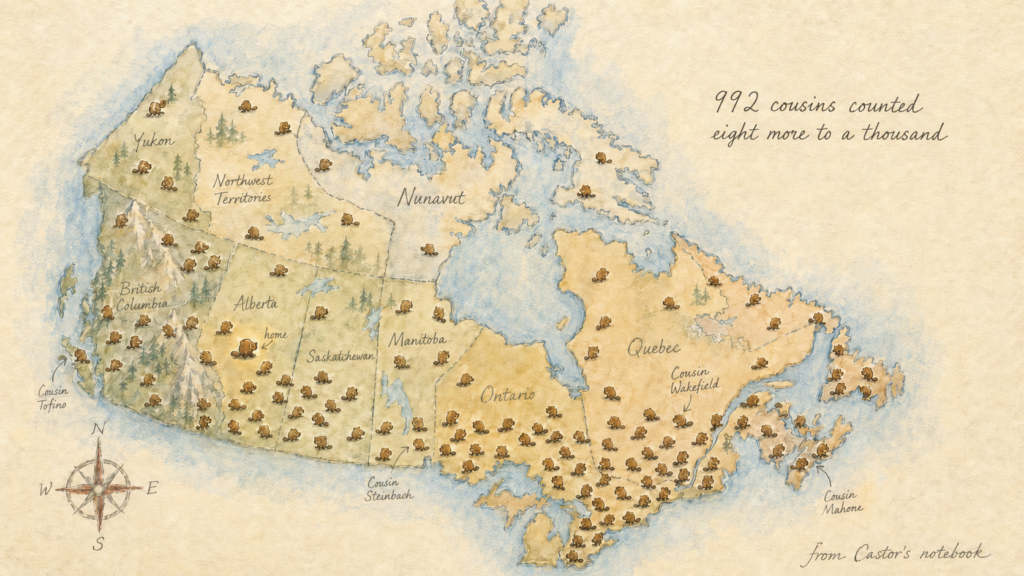
P.S. 992 cousins counted. Eight more to a thousand.
More from the road this week
Castor, Alberta — population 876, where the streams east of Red Deer kept the family in dam-builders for generations.