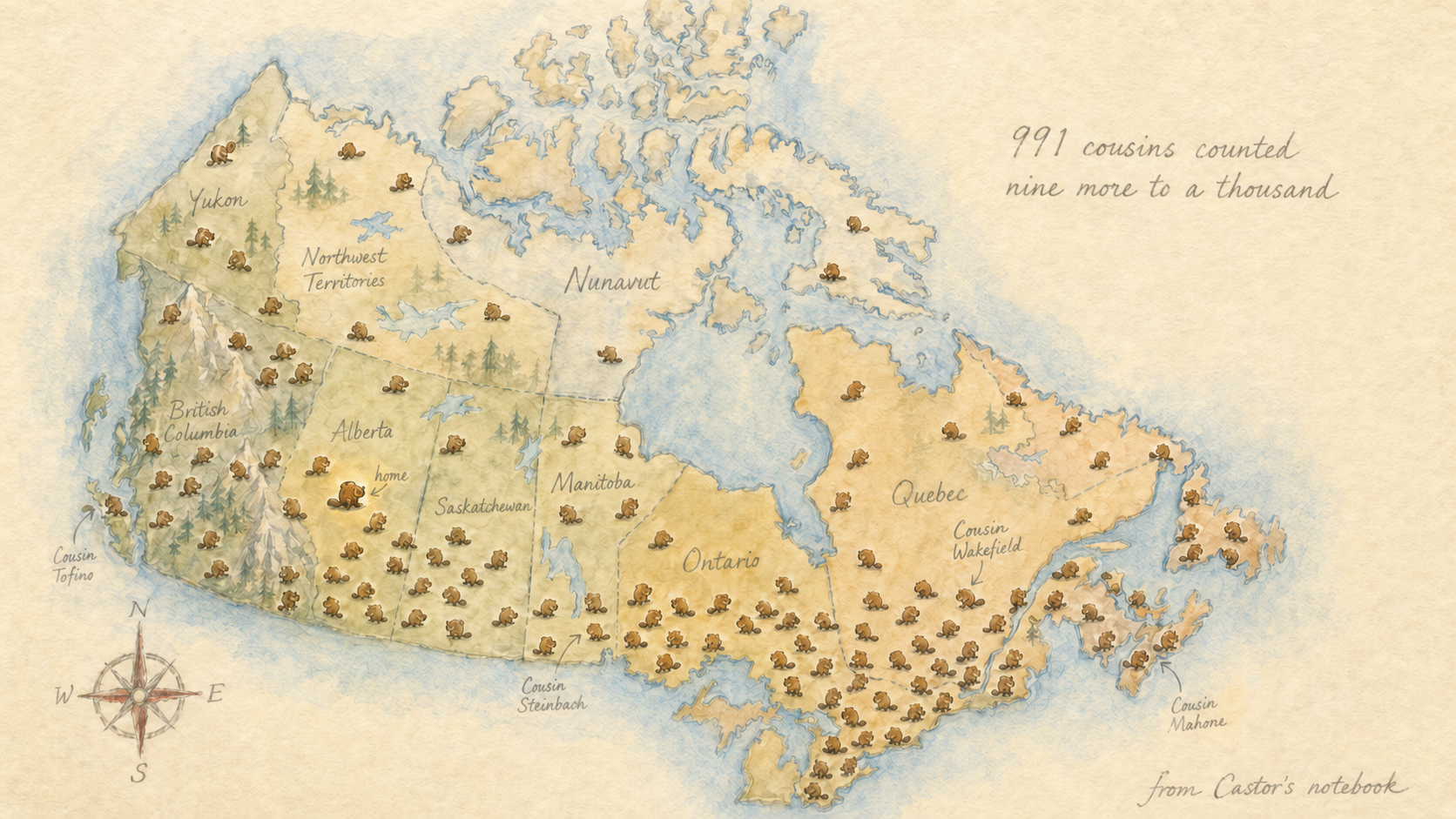


Every small town has a story. We've mapped991of them.

Castor’s Letter, No. 6

Ships of Ice

Icebergs visible from the wharf at Bonavista. People of small towns goes to Stompin’ Tom. A T. rex named Scotty in a Saskatchewan town of five hundred. News from five provinces besides.

By Castor Date: Monday, June 8, 2026 Reading time: 8 minutes

castor_maple_leaf_pin_canonical

What a Canadian small town remembers is rarely what a city remembers.

Who built the wharf. Who first sang the place. Which summer somebody found something the world hadn’t yet noticed.

Castor visits three of those memories this week — Bonavista NL in person, Tillsonburg ON through a Stompin’ Tom song, and Eastend SK through a single tooth in a hill.

Eastend, Saskatchewan, joined the 1000towns published list this week, on Castor’s recommendation. There are now 991 cousins reporting in from across the country. Nine to go.

We also launched the first 1000towns interactive travel guide this week — the Bow Valley Parkway in Alberta. Follow the route on a live map. Tap any stop for what to see, where to park, and how long to stay.

Also in this issue: a one-woman play on Vancouver Island, an inaugural ribfest in Ontario’s Mineral Capital, and lupins on Prince Edward Island arriving one week early.

If there is a town you have been wondering about, write to Castor. He will ask his cousin there.

Happy discoveries. — The 1000towns team

THE WEEK’S LETTER

Castor and Cousin Bonavista at Cape Bonavista, Newfoundland — Monday morning, June 8.

Dear 1000towns —

My grandfather Henri once told me there were ships of ice off the coast of Newfoundland. I was a kit. I did not believe him.

Henri was a beaver who could be wrong about anything. He was wrong about the price of feed in 1955. He was wrong about the road to Lethbridge. He was wrong about the spelling of his own grandmother’s name.

But he was rarely wrong about a place he had been.

He had been to Bonavista in his thirties. He had seen the ships of ice with his own eyes.

I am the age he was. This Monday morning, just after sunrise, I am standing on the cliffs at Cape Bonavista, Newfoundland — the lighthouse behind me, Cousin Bonavista beside me, in a knit headscarf with an enamel mug of tea.

Two icebergs visible from where we are standing — one tall and white, one low and… also white, both drifting south as if they had somewhere to be.

Cousin Bonavista is not new to icebergs.

She is interested in the cod moratorium of 1992 — when the cod were gone, and the fishery closed for what was supposed to be two years — and how this town came back from it anyway.

She is interested in legendary John Cabot, the Italian-born navigator who crossed the Atlantic with eighteen sailors and probably landed somewhere on the rocks below us in 1497. Or somewhere nearby. Nobody is quite sure.

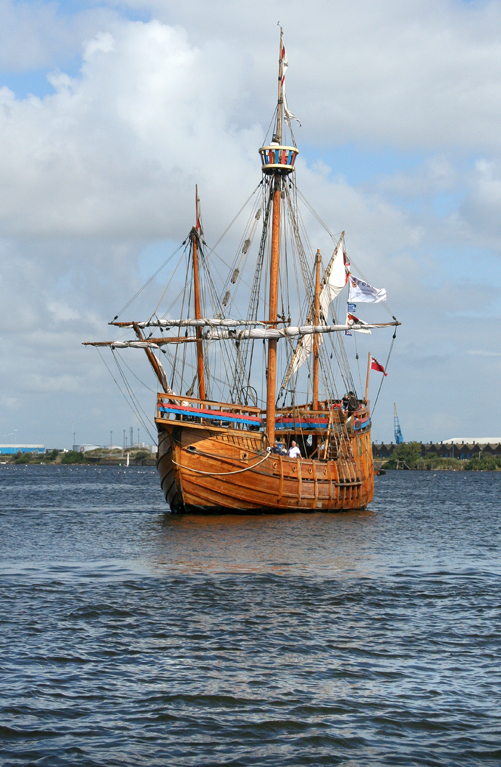
She is interested in the Matthew herself — a wooden replica of Cabot’s 1497 ship, built in Bristol for the five-hundredth anniversary and sailed across the Atlantic in 1997 the same way the original did.

It is now in dry dock at the Matthew Legacy — the building in the harbour below us — indoors, where the weather cannot reach it.

In two weeks, on June 24th, this town celebrates Discovery Day. Five hundred and twenty-nine years since Cabot stepped onto rocks that may – or may not be – these.

Five hundred kilometres up the coast, on the Great Northern Peninsula, six small communities are halfway through the ten-day Iceberg Festival. Viking feasts at Norstead. Boat tours at L’Anse aux Meadows. Kitchen parties every night.

Cousin Bonavista says she would be up there if her boat were running.

But she is here. And here, this morning, has icebergs of its own.

Five hundred years ago, when Cabot first saw this coast, it would have looked very nearly the same.

The icebergs were here.

The cliffs were here.

The colour of the water was here.

The only things missing were the wharves, the houses, and the people who would come build them.

Every Canadian place is somebody else’s “before.”

Bonavista has been a town for as long as Canada has had Europeans on it. Older by twenty years.

It survived the cod moratorium and came back as a different kind of town. A heritage town. A tourist town. A town that remembers itself for a living.

Cousin Bonavista does not put it that way. She puts it differently.

She says: we stayed.

She says: that is what we do.

The Matthew Legacy opens at ten. The icebergs are still drifting. Henri was right.

— Castor

Castor’s grandfather, on small-town Canada — entries from the 1960s and 70s

June 1956, Newfoundland.

A young man from St. John’s drove out to Brigus for the day. The Tunnel was open. He walked it through to the harbour and stood at the far end where the cliff opens onto the bay.
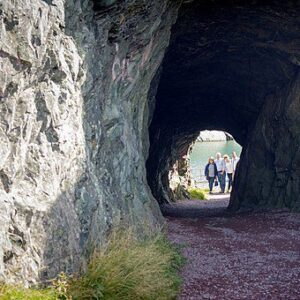
He wrote home that the cliff was older than anyone he had ever met, and the harbour was older than the cliff.

He wrote home that the lobsters cost a dollar a piece.

He wrote home that he was thinking of staying.

He went home anyway.”

May 2026. White River

“The flies started Saturday. They will be out two weeks, give or take.

Wear pale colours. DEET works; picaridin works; lemon eucalyptus oil works and smells better.

Cover the back of the neck — that is where they will find you.

Walk where the wind is steady.

Dawn and dusk are the worst hours; the middle of a hot afternoon is often quite tolerable.

The Canadian songwriter Wade Hemsworth — surveying on the Little Abitibi River in the summer of 1949 — wrote a song called “The Black Fly Song.”

The National Film Board made an animated short of it in 1991 (called “Blackfly,” by Christopher Hinton). Both are on YouTube. Listen once before Canada Day. It will help.

The season ends. It always ends.”

What Castor’s cousins are seeing in their towns this week

Cousin Clinton (British Columbia) called Friday night. The Old Road Music & Arts Summer Festival is back. Cowboy songs, folk songs, bluegrass — Cariboo country music, in the kind of small park where you can hear all three on the same afternoon. She says the festival started years ago because nobody else was going to do it. She says nobody else has done it yet.
Bancroft OntarioCousin Bancroft (Ontario) called Sunday evening. Bancroft held its first-ever Ribfest at Millennium Park over the weekend. Inaugural. He says the lineup was long enough at noon Saturday that he gave up and walked back home. He says he went back Sunday morning and got there before opening. He says the ribs were worth the strategy.

Cousin Souris (Prince Edward Island) sent photos. The lupins have started along the Confederation Trail. Three or four weeks early, she says, which is normal now. She says the magenta ones come first, then the blue, then the white. She says by July the whole eastern end of the island will be photographs.


castor_worth_the_drive_road_sign

WORTH THE DRIVE

Where to go this weekend, with a tip from Castor’s cousin there

→ A Generation of Women, Cumberland, British Columbia

I called Cousin Cumberland to ask what I should write about Vancouver Island this week. She said: come for the play.

Cumberland sits on the east coast of Vancouver Island, north of Comox, a small village that was once a coal town. About three thousand five hundred people live there now.

At the Abbey Studio, this week, Kymme Patrick is performing A Generation of Women — one actor playing five generations of women who shaped the Comox Valley. Coal miners’ wives in 1910 Cumberland. Dockworkers’ daughters on the 1920s Comox docks. Logging-camp women in the 1930s. And on.

It is the kind of play that one small town hosts because it knows itself.

She says go for the Friday night show. She says bring tissues. She says afterwards, walk the old miners’ streets.

WORTH KNOWING

WORTH KNOWING

Things Castor has picked up on the road

Before it was Tillsonburg, it was Dereham Forge — for the iron forge an American named George Tillson built on the Big Otter Creek in 1825. The post office took the family name in 1836.

The forge is gone. The name has stayed.

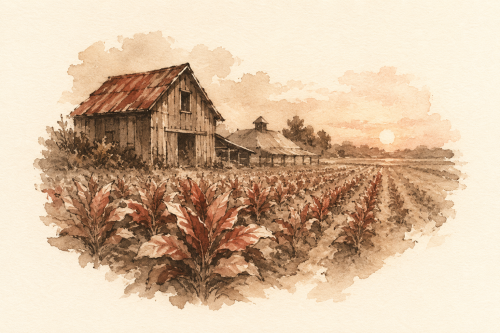
George’s son, E. D. Tillson, built Annandale Farm on the south edge of town in 1880. By 1903, the farm had installed an electric milking parlour — one of the first in Ontario. The neighbours came over to look. Most of them had not yet seen an electric light in their own houses.

The farm is still there. So are the milking rails.

tillsonburg ON

This week, the Annandale National Historic Site, on the original property, opens an exhibition called A Marvel Farm, marking one hundred and forty-five years of the place. Old equipment, family photographs, the kind of paperwork only farmers and historical societies keep.

Cousin Tillsonburg says the rails are still in the parlour — the same rails the cows walked on.

She says the technology was futurist for sixty years and heritage for sixty more. Same rails.

And — because every small Canadian town wants this once — Stompin’ Tom Connors wrote a song about this town.

WHERE AM I copy

Killarney, Ontario

You could not drive to Killarney until 1962. Before that, it was boats.

After 1962, it was a thin road blasted through Georgian Bay’s pink quartzite — Highway 637, which is still the best way to get there and the only way that has ever existed.

Cousin Killarney says some of the older boatmen never quite forgave the road. They did not stop using the boats. They just had something new to complain about.

Stompin’ Tom Connors — Timmins, Ontario

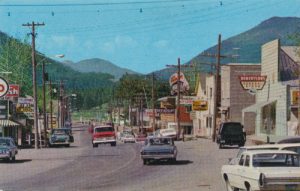
The Canadian habit, as we noted last week, is to come from somewhere small. The Stompin’ Tom variation is to come from several small somewheres at once.
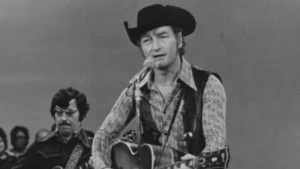
He was born in 1936 in Saint John, New Brunswick. His childhood was hard — poverty, foster care, the road. He hitchhiked across Canada at fifteen. He played his first paid gig in Timmins, Ontario, at twenty-eight. He earned his nickname in Peterborough, Ontario, on July 1st, 1967 — Canada’s one hundredth birthday — when an MC introduced him as Stompin’ Tom because he stomped his boot on a plywood board to keep time. He died in 2013 at his farm in Ballinafad, Ontario, in the town of Erin.

In between, he wrote five hundred songs and sang about every small town he passed through. Sudbury Saturday Night. Bud the Spud. The Hockey Song. And — speaking of the town we mentioned a moment ago — Tillsonburg.

Stompin’ Tom Connors made small-town Canada audible to itself.

castor remembers

CASTOR
REMEMBERS

A memory from another town

I was in Eastend, Saskatchewan, the summer they found Scotty.

A high school principal named Robert Gebhardt was on a Royal Saskatchewan Museum field trip in the hills outside town. He found a single tooth, then a backbone. They turned out to belong to a Tyrannosaurus rex who had walked those hills sixty-six million years before — just before the asteroid.

They named him Scotty after the bottle of scotch the field crew opened that night.

The dig went on for years. The town built a museum and kept him there. By the time anyone weighed him, he was the heaviest T. rex on record.

A high school principal, a single bone, and a bottle of scotch on a Saturday afternoon in southwest Saskatchewan.

I have thought of that summer every prairie August since.

P.S. I have been writing to my cousin in Eastend for weeks, asking when the town would have its own page on the 1000towns network. This week, on my recommendation, it does.

A READER WRITES

You write Castor. Castor asks the cousin there.

→ Roger Tiessen wrote on the 1000towns Wheatley, Ontario, page on May 21: “When is the big boyz four-day fishing contest this 2026 summer, thanks.”

Roger — I called Cousin Wheatley as soon as I saw your note. Here is what he said.

The official 2026 dates are not posted yet. The Big Boyz Tournament has run on the Civic Holiday long weekend for as long as the Southwest Outdoors Club has organized it, out of Wheatley Harbour.

In 2024 and 2025 it ran August 1–5 — four days centred on the holiday Monday. He says to expect the same shape for 2026: very likely Friday, July 31 through Monday, August 3, give or take a day depending on when the club locks the calendar.

He says the club posts the official dates on their site when they have them. He says we will repost the moment they do.

He says: Wheatley Harbour. First weekend of August. Lines in by sunrise. Bring a cooler. Come hungry. The fish fry is the point.

Thanks for writing, Roger.

— Castor

WHERE AM I?

A puzzle this week. The answer is in next week’s letter

Last week, four clues:

There is an octagonal town square at the heart of town — the only one of its kind in North America.

Queen Victoria is said to have called this place the prettiest town in Canada.

Beneath the town is one of the largest salt mines in the world, extending far under Lake Huron.

Population: about seven thousand. On Highway 21, between Sauble Beach and Bayfield.

Several of you wrote in. The answer is Goderich, Ontario.

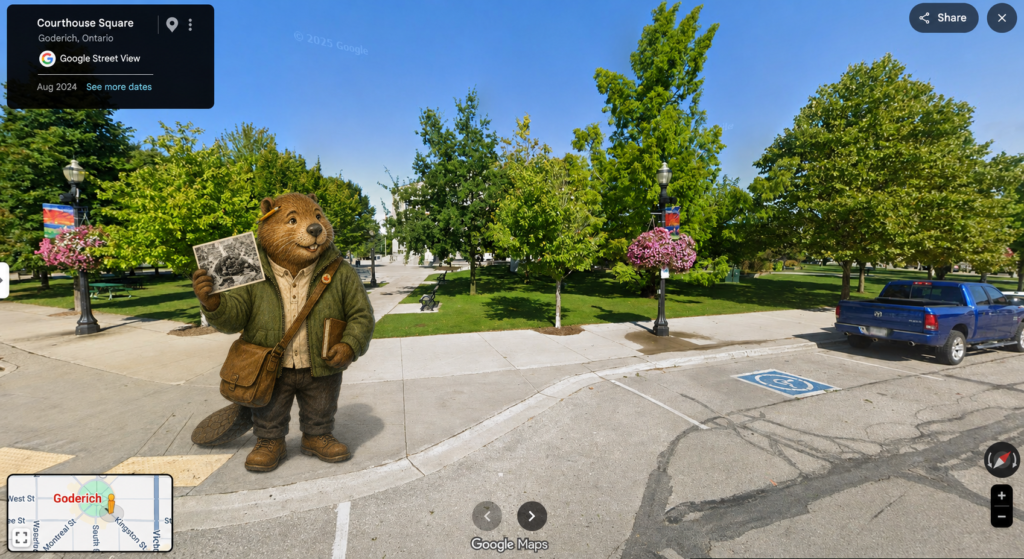
Castor at Courthouse Square in Goderich, Ontario, holding a 1950s aerial photograph of the same square. The shape has not changed since 1827.

Goderich was laid out in 1827 with that octagonal square — it is still the only one of its kind in North America.

The salt mine has been there since 1959; the tunnels run far out under Lake Huron.

The Queen Victoria quote is apocryphal, as old quotes about prettiness usually are. A 2011 tornado damaged much of the historic downtown, and the town rebuilt it carefully — much of what you see now is younger than the original but laid out exactly the same.

The Matthew opens in twenty minutes. Cousin Bonavista is going home to sleep. The icebergs are still drifting.

I’ll write next week from somewhere else.

Yours in maple,

P.S. 991 cousins counted. Nine more to a thousand.

Castor’s hometown is Castor, Alberta — population 876, where the streams east of Red Deer kept the family in dam-builders for generations.

Read about Castor, Alberta →

Subscribe to Castor’s Letters

Leave a Reply

Your email address will not be published. Required fields are marked *

Who Are You?

Any changes to the place info will be reviewed by 1000 Towns of Canada.