


From Claremont & Owen Sound, Ontario
Thomas John “Tom” Thomson was one of Canada’s most influential landscape painters. He painted seriously for only five summers — and helped teach a country how to see itself.
- Born: August 5, 1877, in Claremont, Ontario
- Grew up: on a farm at Leith, north of Owen Sound, Ontario
- Died: July 8, 1917, on Canoe Lake, Algonquin Provincial Park, aged 39
- Buried: Leith United Church Cemetery, Leith, Ontario
- Output: more than 400 oil sketches and about 50 canvases in five painting summers
- Legacy: three years after his death, seven of his friends formed the Group of Seven. They always said there would have been no Group of Seven without him.

The West Wind, winter 1916-1917
“It may interest you to know that the “West Wind’ was done at Lake Cauchon. Thomson, myself, Lorne (sic) Harris… were up there. It was blowing very hard and Lorne Harris was painting further up shore. The wind blew down the tree of the picture and Harris at first thought Thomson was killed but he soon sprang up, waved his hand to him and went on painting.”
MacCallum to Mrs. A.C. Beatty, also in Reid, The Jack Pine, 18-19
A life mapped in small places
Tom Thomson did not come from one town. He came from a map of them.
He was born in Claremont, Ontario — a village on a wooded ridge east of Toronto, in Durham Region — on August 5, 1877. He left when he was two months old. His family moved north to a small farm at Leith, on the east shore of Owen Sound.
He grew up at Leith. He is buried at Leith. In between were fifty years of walking a country that was still learning to name itself.
Chatham, Seattle, Toronto
In 1901, Thomson attended Canada Business College in Chatham, Ontario, to study penmanship and commercial design. He briefly moved to Seattle to work as a commercial artist. He returned to Toronto in 1905 and settled into work as a graphic designer.
At Grip Ltd. and later Rous & Mann — two Toronto graphic design firms — he met the men who would later form the Group of Seven: J. E. H. MacDonald, Arthur Lismer, Franklin Carmichael, and Frederick Varley. Lawren Harris and A. Y. Jackson joined the circle soon after.
He did not paint at all seriously until he was in his thirties.
The five summers
In the spring of 1912, at thirty-four, Thomson took his first sketching trip to Algonquin Provincial Park with a friend from work. He came back with a handful of small oil-on-board sketches and the direction of the rest of his life.
Later that same year, he took a two-month canoe trip with William Broadhead to the Mississagi Forest Reserve on the north shore of Lake Huron, near Sudbury. That trip turned an illustrator into a painter of the wilderness. Two of his early masterworks, The Canoe and View on the Mississagi, came out of it.
In July 1914 he paddled up the Seguin River into Parry Sound, stayed a few days in the South Channel, and painted Trestle at Parry Sound and Parry Sound Harbour. That same year he continued north up the eastern shore of Georgian Bay to Byng Inlet, where he painted the timber yards and the mouth of the Magnetawan River — the trip that gave him Spring Ice.
For the final five summers of his life, Thomson was in Algonquin every spring and every autumn, sketching. In the summers he worked as a fire ranger and a guide. He paddled Canoe, Smoke, Tea, Joe Lake, and a dozen more. He camped beside them. He made small oil-on-board panels no bigger than a paperback book while the light was still doing what he needed it to do.
In the winters, he came back to a small wooden building behind the Studio Building on Severn Street in Toronto. He called it the Shack. There, he turned his summer sketches into the larger canvases that would become the country’s iconic images — The Jack Pine, The West Wind, Northern River, and dozens more.
In five painting summers he made more than four hundred sketches and about fifty canvases. That is close to two paintings for every week of every summer of his life as an artist.
Canoe Lake
On the morning of July 8, 1917, Tom Thomson paddled onto Canoe Lake and did not come back. On July 16, his body was found.
There was a still lake that morning. There was another paddler on the water. There was a body found eight days later, with a bruise on the temple and fishing line wrapped once around one ankle. There was a coroner’s ruling of accidental drowning. There was a burial at the lake, a re-burial arranged by the family, a controversial 1956 grave dig at Canoe Lake by a man who did not believe the family had taken the right body home.
Every summer somebody writes a new book. Canoe Lake has never given up its answer.
A memorial cairn stands on Hayhurst Point on the western shore of the lake, where his overturned canoe was recovered.

Tom Thomson, Canoe Lake in Algonquin Park, Ont., in 1914.
National Archives of Canada/Blair Laing

Memorial on Canoe Lake
The Group of Seven — and the Shack
Three years after his death, in 1920, seven of Thomson’s friends formed the Group of Seven in Toronto. They always said there would have been no Group of Seven without him.
In 1962, the McMichael Canadian Art Collection in Kleinburg moved Thomson’s entire Shack — walls, floor, woodstove, window frame — from behind the Studio Building in Toronto to a wooded hillside north of the city, where it still stands today. Visitors can walk inside.
The Tom Thomson Art Gallery in Owen Sound holds a nationally significant collection of Thomson’s work and artifacts. His grave is a few kilometres up the road, in Leith. The Jack Pine is at the National Gallery of Canada in Ottawa. The West Wind is at the Art Gallery of Ontario in Toronto.
A country of small places
Tom Thomson did not paint Canada. Not really. He painted little corners of it — a bend in a river, a jack pine leaning into the wind, spring ice breaking apart, morning mist on a lake most travellers hurried past.
He didn’t teach us how to paint trees. He taught us how to notice them.
Claremont gave him a beginning. Leith gave him a childhood. Chatham gave him a business school. Toronto gave him a trade. Parry Sound taught him to notice. Byng Inlet taught him the power of weather. Mississagi taught him wilderness. Algonquin taught him silence. Kleinburg gave him a place to come home to, forty-five years after his death.
No one place made Tom Thomson. Together they did.
Places on Tom Thomson’s map
- Claremont, Ontario — birthplace, August 5, 1877
- Owen Sound, Ontario — grew up on a farm at Leith, north of town; the Tom Thomson Art Gallery is downtown on First Avenue West
- Parry Sound, Ontario — painted Trestle at Parry Sound and Parry Sound Harbour in July 1914; two Artist’s Stations let visitors compare the paintings to the view today
Featured on 1000towns.ca — People of Small Towns. Every small town has a story.
***
***
Claremont
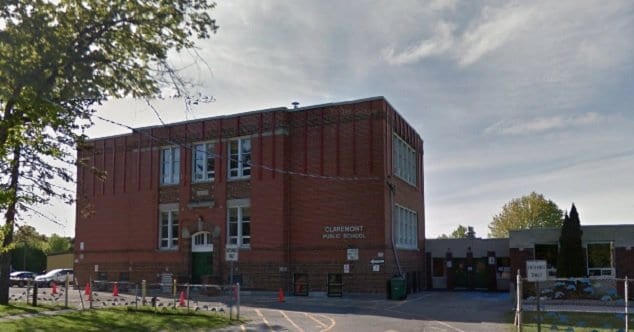
Claremont is a Southern Ontario community located in the north part of the City of Pickering, Ontario.


Claremont is well known in the local area for its annual “Yard Sale Day”, an event where all residents are invited to host simultaneous garage/yard sales. The sale is typically held on the second or third Saturday of June.