
Castor's Letter · No. 11
→ Castor wonders why small towns build giant things. → Astronaut Jeremy Hansen, back to Ingersoll after flying past the Moon. → Two hockey drafts in ten days — the first Yukoner and the first Islander. → Cardigan, and the Islander who grew the World Cup’s grass. → And a full country of cousins besides.
By Castor · Monday, July 13, 2026 · 13 min read
Towns Castor mentioned this week
The watercolour illustrations in Castor’s Letters are made with a mix of original photography, editorial design, and AI illustration tools, curated by our team. Words and editorial decisions are entirely human.
Every country has its measure.
Some are measured by their armies. Some by conquered territory. Some by GDP.
Canada is enormous on any map — six time zones, three oceans, more coastline than any country on earth.
But that is not the measure Canadians talk about.
The measure we talk about is
Canada’s measure is affection.
This week, Castor is in Duncan, British Columbia, trying to figure out what that means.
If there is a town you have been wondering about, write to Castor. He will ask his cousin there. Happy discoveries. — The 1000towns team
‘Dear 1000towns —
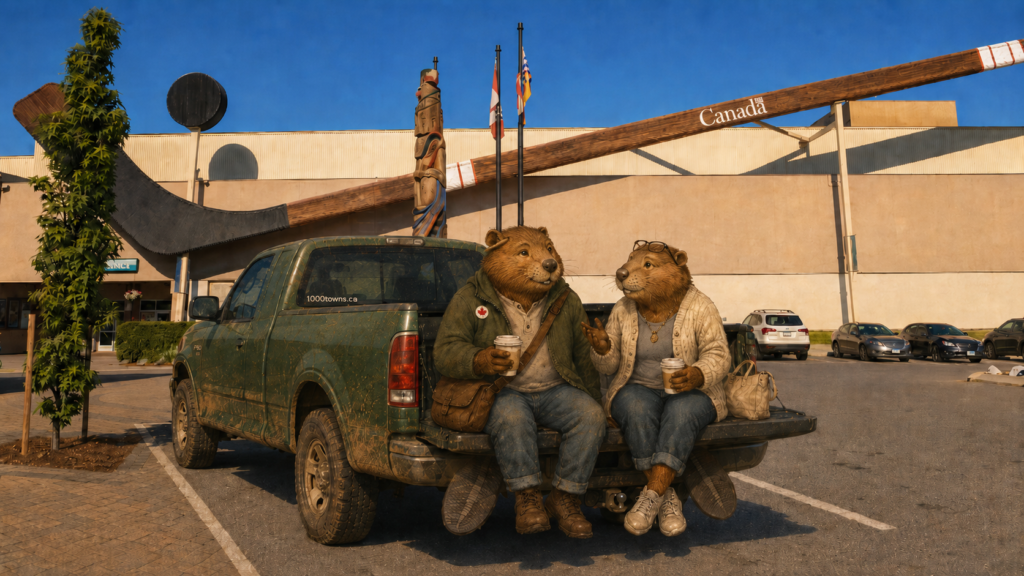
I was sitting on the tailgate of my truck in the parking lot of the Cowichan Community Centre, in Duncan, British Columbia. Cousin Duncan had brought two coffees.
Behind us, on the wall of the centre — longer than the roof of the arena it hung from — hung a hockey stick two hundred and five feet long. Beside its blade, a black puck to match.
It was Day 17 of 39 Days of July — the Cowichan Valley’s annual summer festival, thirty-nine consecutive days of music and community across the town, June 26 through August 3. The main stage was downtown at Charles Hoey Park. Cousin Duncan had walked me up here first.
She raised her cup.
“People always ask why we built such a huge hockey stick,” she said. “I tell them they’re asking the wrong question. The real question is, why do Canadians keep making ordinary things huge?”
I looked at the stick.
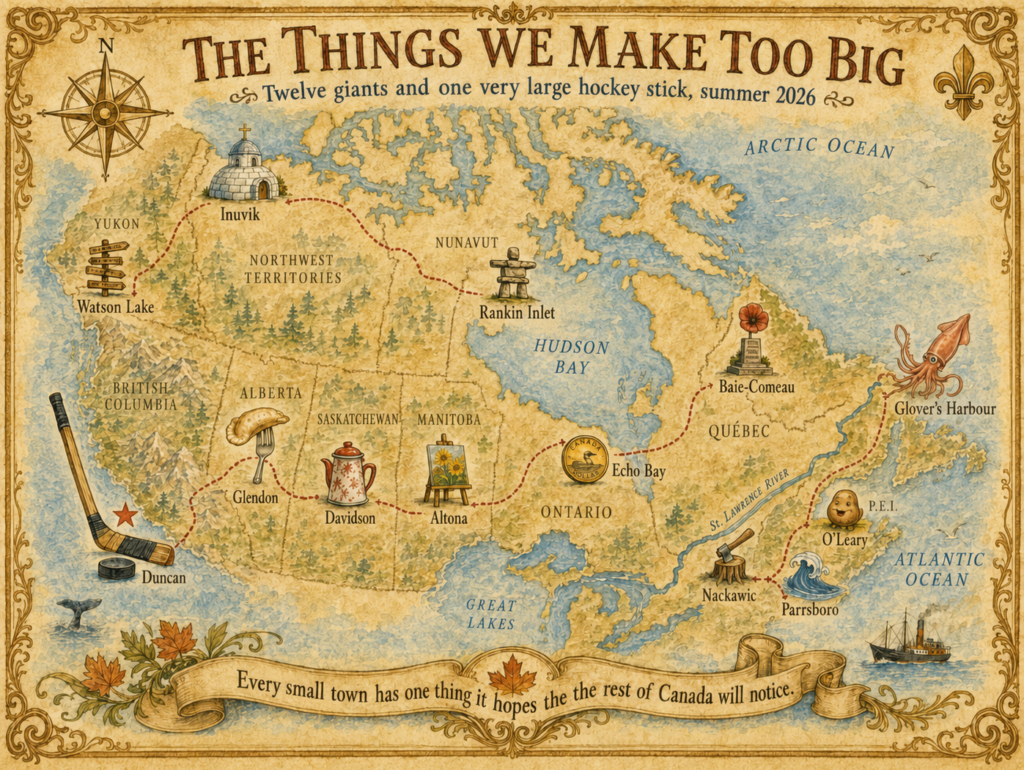
For three weeks, my phone had been full of cousins. Everyone had a giant something to point at — festival season everywhere.
I thought about what they had told me.
✦ ✦ ✦
Cousin Lewisporte called on Sunday morning to wish me a happy Twelfth — the Newfoundland civic holiday tomorrow. “If you come east,” he said, “drive another hundred kilometres to Glover’s Harbour. You have to meet the squid.”
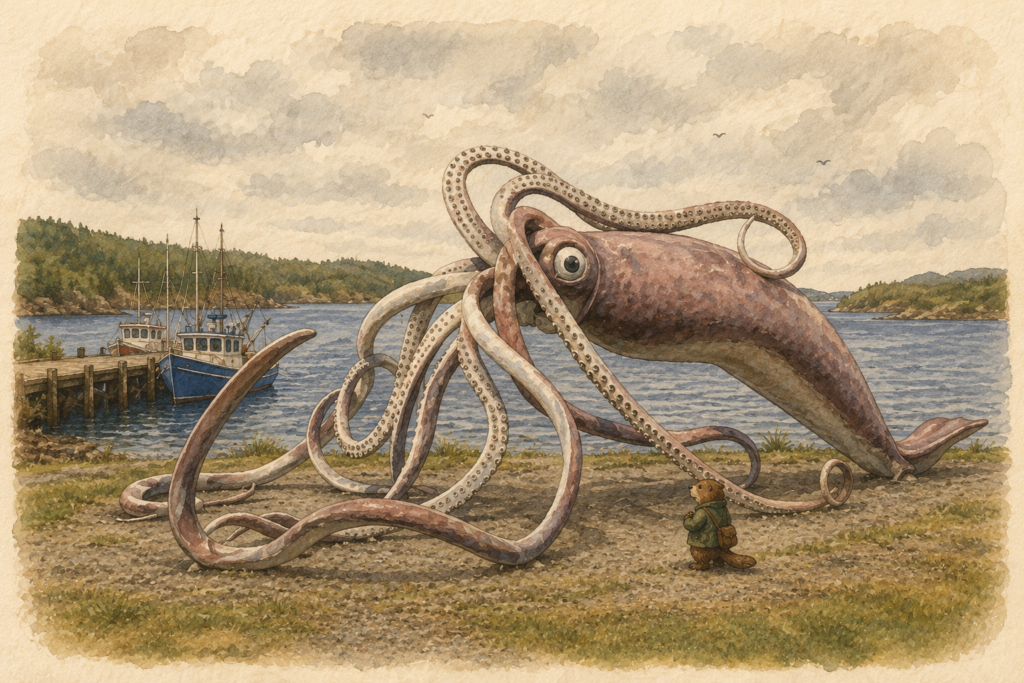
In a small waterfront park lies a fifty-five-foot fibreglass giant squid. It isn’t an exaggeration. It’s a careful copy.
Almost 150 years ago — in 1878 — three fishermen at nearby Thimble Tickle hauled in one of the largest giant squids ever scientifically recorded. They fought it with an axe. Its tentacles stretched nearly thirty feet. Its body, twenty.
“People think we made the statue too big,” Cousin Lewisporte said. “The funny thing is, we didn’t. The sea did.”
I told you about it in my last letter: this week the fields around O’Leary are changing colour. For seven days in July, the potato plants bloom — first white, then purple. Today, the Potato Blossom Festival begins.
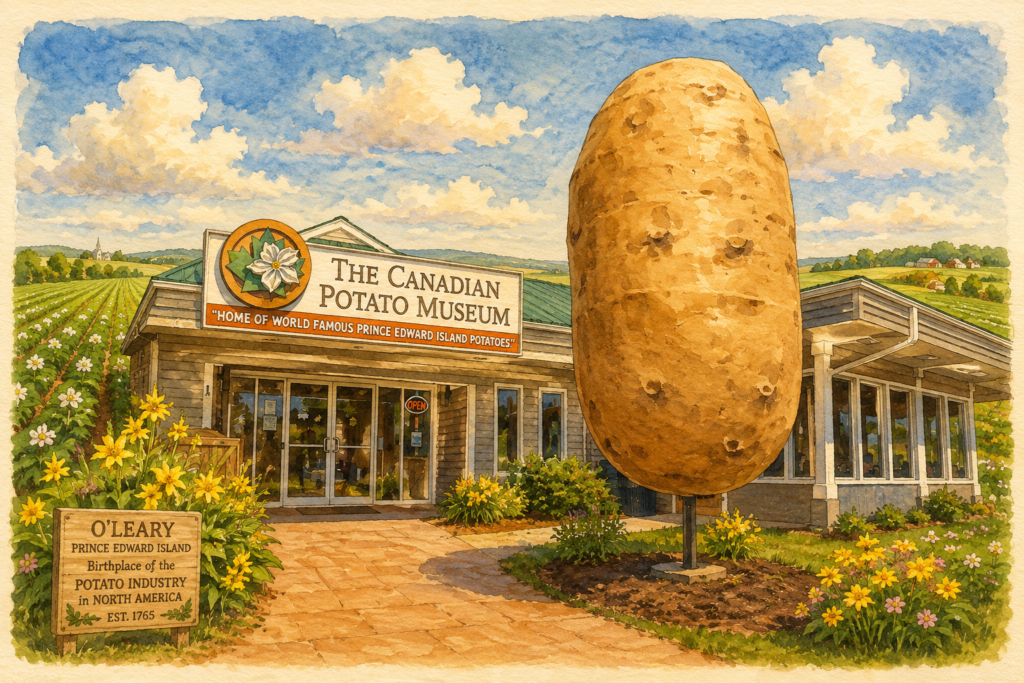
Outside the Canadian Potato Museum stands a fourteen-foot potato with a plain, unsmiling face.
“Visitors always photograph the potato,” Cousin O’Leary said. “Then they drive past the fields.”
She looked toward the blossoms.
“The fields do the real work. The potato just reminds people where to look.”
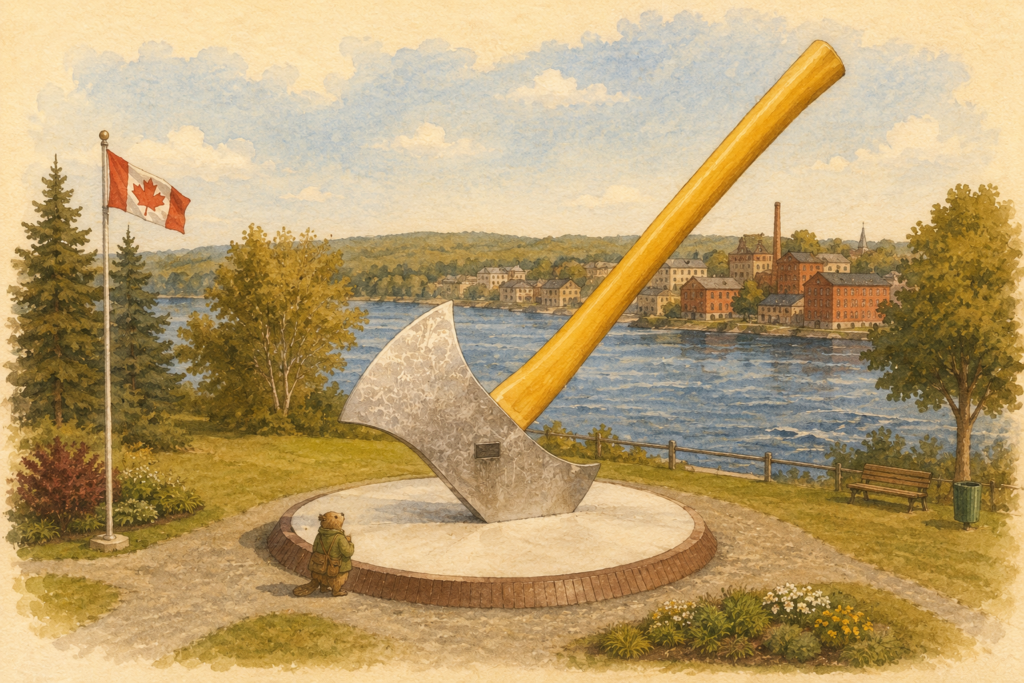
Cousin Nackawic says the biggest thing in town is an axe. Fifteen metres tall, made of stainless steel, its blade buried in a concrete tree stump.
At first, I thought it was a monument to logging.
Then he told me about his grandfather. He spent his life in the woods before the Mactaquac Dam flooded the old village and the town moved to higher ground.
“The axe isn’t really about the trees,” he said. “It’s about the people who swung the smaller ones.”
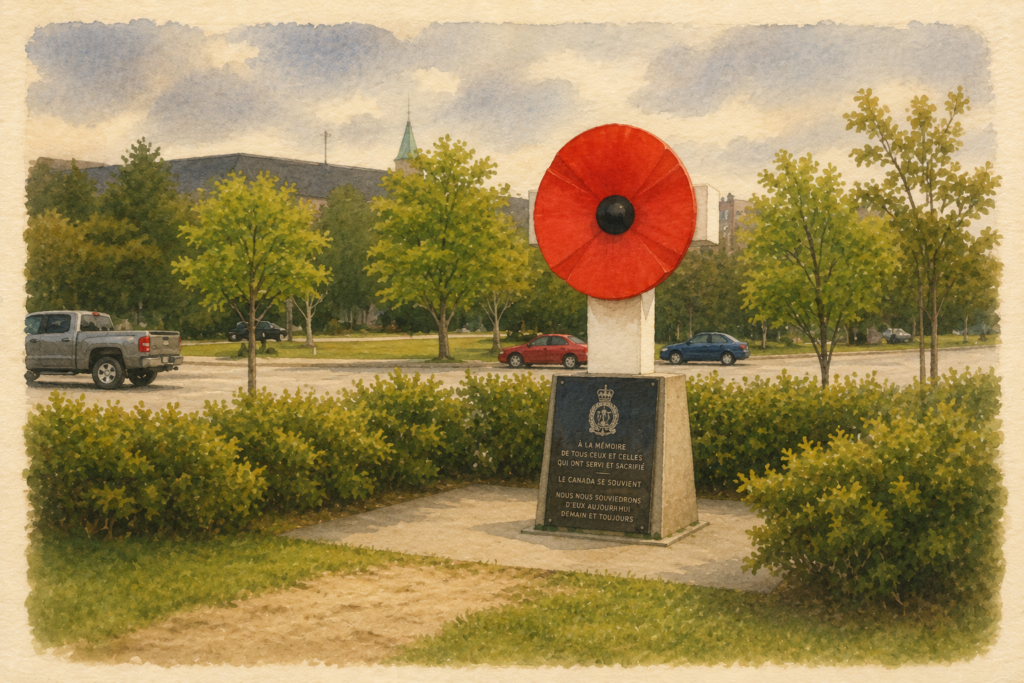
Cousin Baie-Comeau said every country chooses what to make enormous. Here, they chose a poppy.
Not a general. Not a soldier. Not a rifle. A flower.
It stands beside the road, bright red against the North Shore sky. The plaque remembers local men who never came home from war.
“The flower isn’t really the monument,” she said.
“The remembering is.”
Cousin Altona called this week to remind me that the Manitoba Sunflower Festival begins on July 24.
“You should come back,” she said. “The fields will all be yellow.”
“I’m afraid I’ll be home by then.”
“Then at least remember Vincent,” she said.
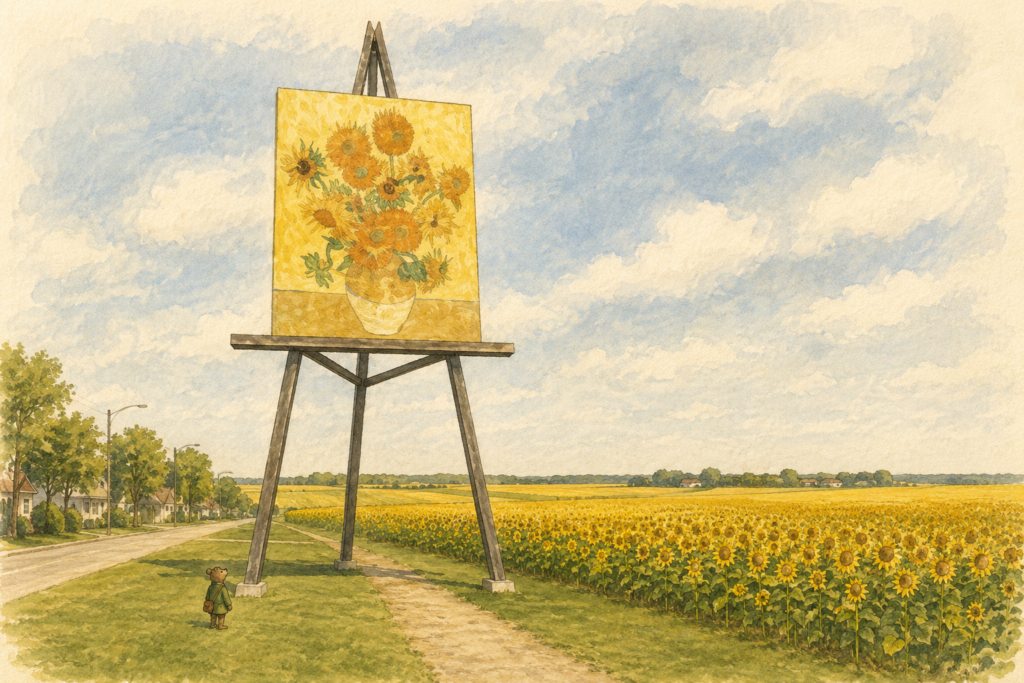
The giant easel beside Highway 30, holding a full-scale copy of Van Gogh’s Sunflowers, was the first one New Zealand artist Cameron Cross ever built, back in 1998. He dreamed of placing seven around the world in sunflower-growing regions. Today, only three exist — in Manitoba, Emerald, Australia, and Kansas.
The very first one stands in Altona.
Cousin Altona looked across the prairie.
“Vincent never made it to the Prairies.” She smiled. “The Prairies made room for him anyway.”
Last June, I wandered through Davidson Days carrying a pancake breakfast on a paper plate.
This year, Cousin Davidson tells me the parade was just as good, and nobody complained that the coffee ran out.
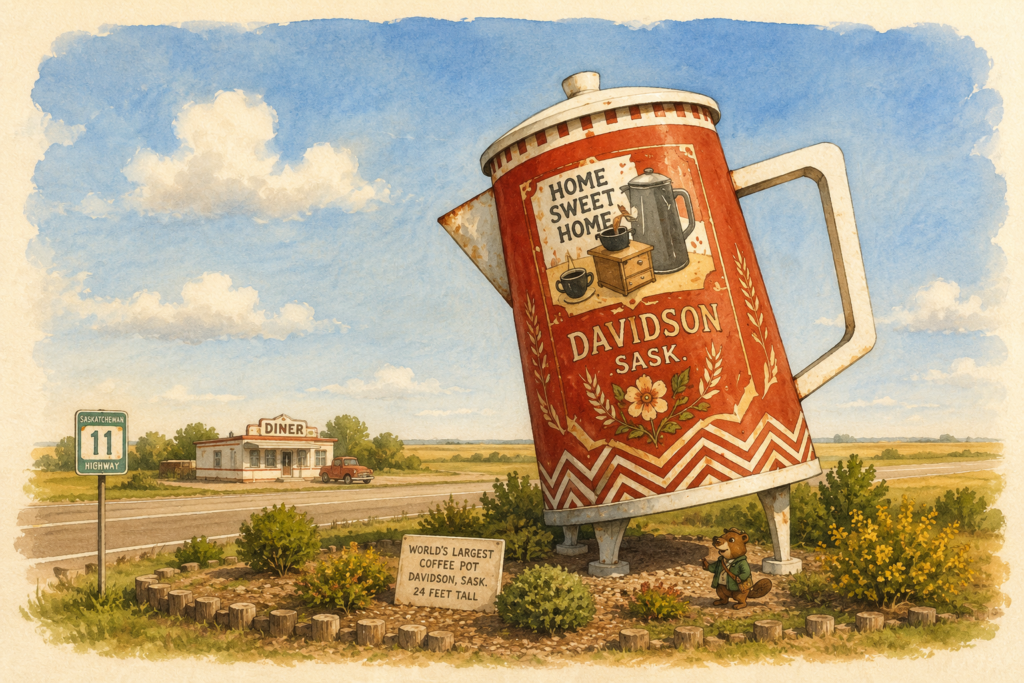
The giant coffee pot still stands beside Highway 11, welcoming travellers halfway between Regina and Saskatoon. Twenty-four feet tall. Red and white.
Cousin Davidson runs the diner across the road.
“About one car in three that stops for the coffee pot comes in for coffee,” he said, pouring me another cup. “I suppose the other two just needed a reason to stop.”
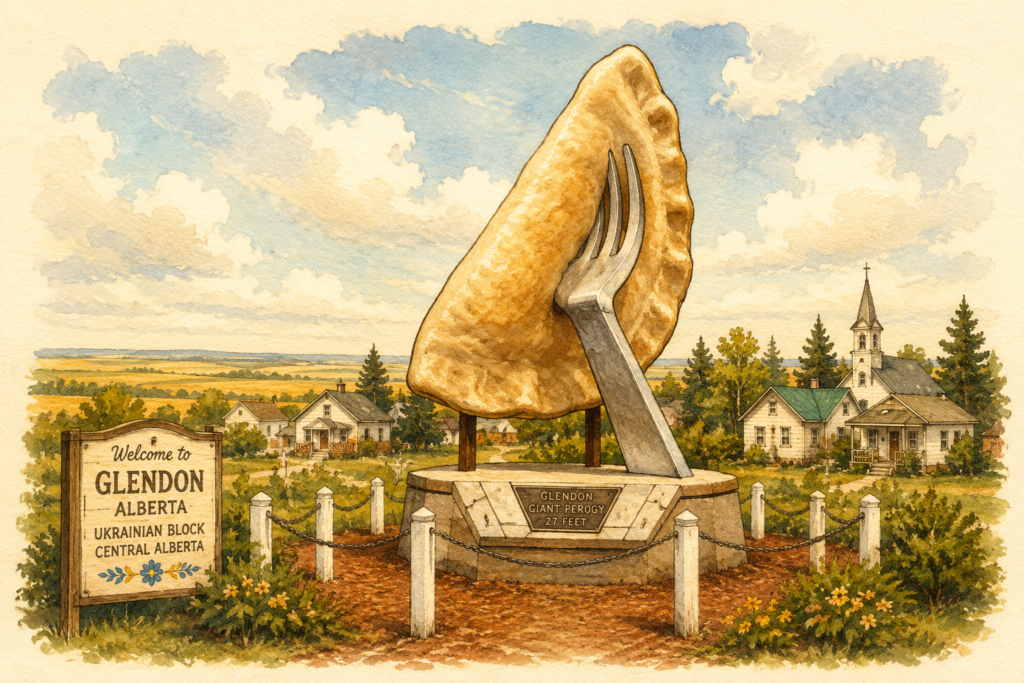
Cousin Glendon says the Pyrogy Festival is still two months away.
“But Grandmother would tell you every day is perogy day.”
The giant perogy has stood in the village park since 1991. Twenty-seven feet tall. Balanced on a fork.
Glendon was settled by Ukrainian families who came from Bukovina and Galicia. They didn’t all speak the same way. They didn’t all build the same houses. But almost every family brought a perogy recipe.
Cousin Glendon still uses her grandmother’s.
“Nobody makes them exactly the same,” she said. “I think that’s why we built only one giant one.”
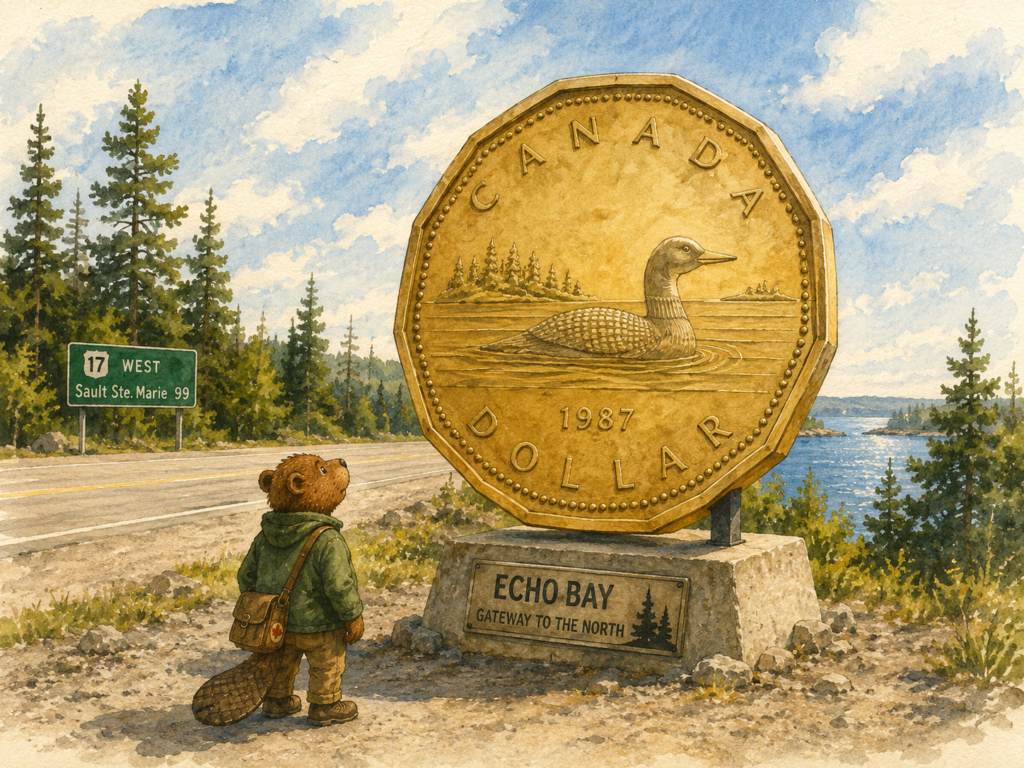
Cousin Echo Bay asked me to stop by the Echo Bay Extravaganza next weekend. “Everyone comes for the fair,” he said. “But before you leave, meet the loonie.”
Outside town stands a giant one-dollar coin. It isn’t there because Echo Bay is rich.
It’s there because one of its neighbours, artist Robert-Ralph Carmichael, sketched a loon on a quiet northern lake. When the Royal Canadian Mint suddenly needed a new design for Canada’s dollar coin, that sketch became the loonie.
We’ve all carried Echo Bay in our pockets since 1987.
Cousin Echo Bay looks at the giant coin and laughs: “Not bad for a small-town drawing.”
I asked Cousin Watson Lake how long it takes to walk through the Sign Post Forest.
She laughed. “That depends.”
“On what?”
“How often you stop.”
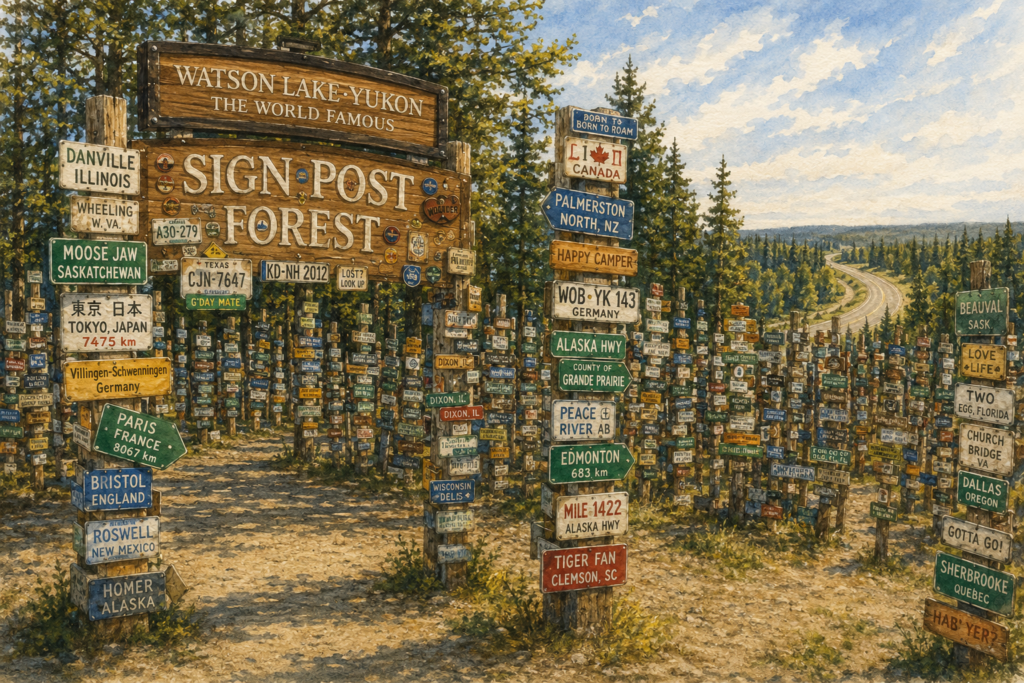
Every few steps there is another place. Moose Jaw. Oslo. Medicine Hat. Tokyo. A tiny village in Germany. A street in Brazil.
“It started with one homesick highway worker,” she said.
In 1942, while helping build the Alaska Highway, American soldier Carl K. Lindley was asked to repaint a direction sign. Before he put down his brush, he added one more:
DANVILLE, ILLINOIS — 2,835 MILES.
The next traveller added another. Then another. Today, there are more than ninety thousand.
Most towns build one giant thing. Watson Lake built one together — the biggest monument of all.
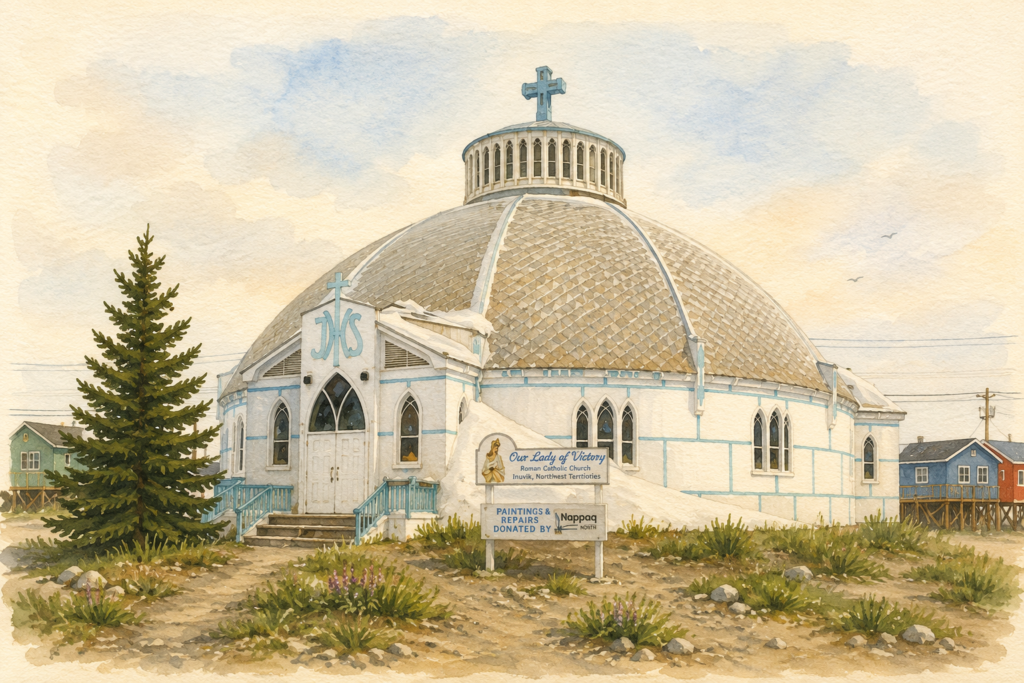
The biggest igloo in Inuvik doesn’t melt. It has a cross on top.
Cousin Inuvik says everyone calls it the Igloo Church, even though it has never been made of snow.
Brother Maurice Larocque designed it that way in 1958, because he thought a church above the Arctic Circle should look as though it belonged there.
Cousin Inuvik still sings there.
“The sound goes up,” he said. “And somehow it comes back warmer.”
He says visitors photograph the outside. The people of Inuvik remember the inside.
Then Nova Scotia called.
Cousin Parrsboro said I should stop looking for giant things made of steel and fibreglass.
“Come meet a giant made of stories.”
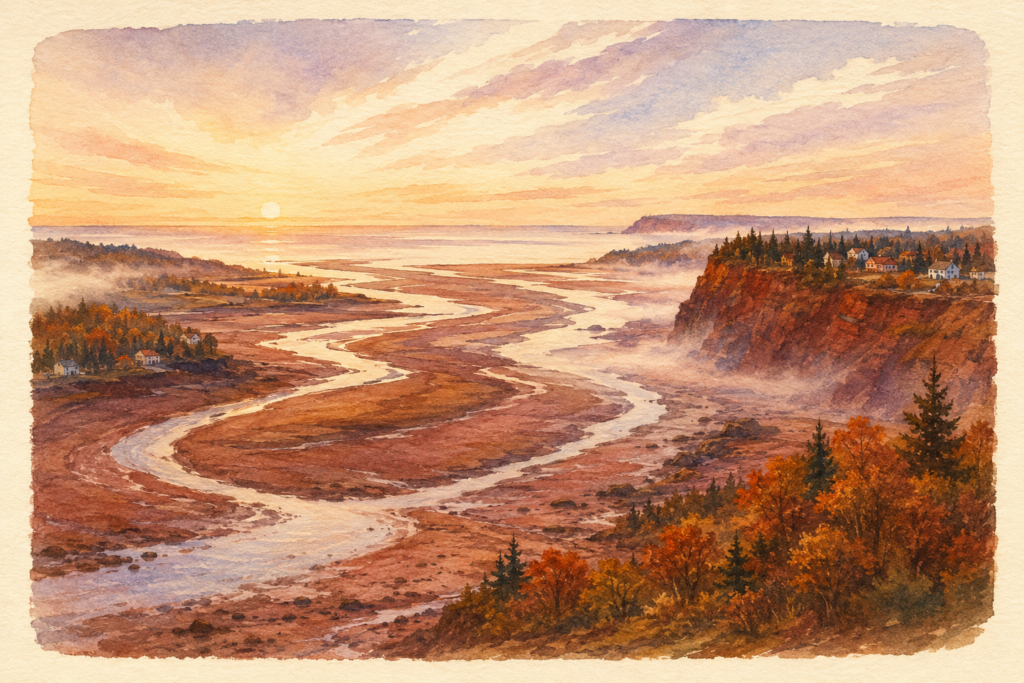
Above the Bay of Fundy stands Glooscap, the great cultural hero of Mi’kmaq tradition. Long before there were highways or provinces, people here told stories of Glooscap shaping this coastline and creating the tides.
Cousin Parrsboro says every place has a history.
Not every place remembers that history begins before maps.
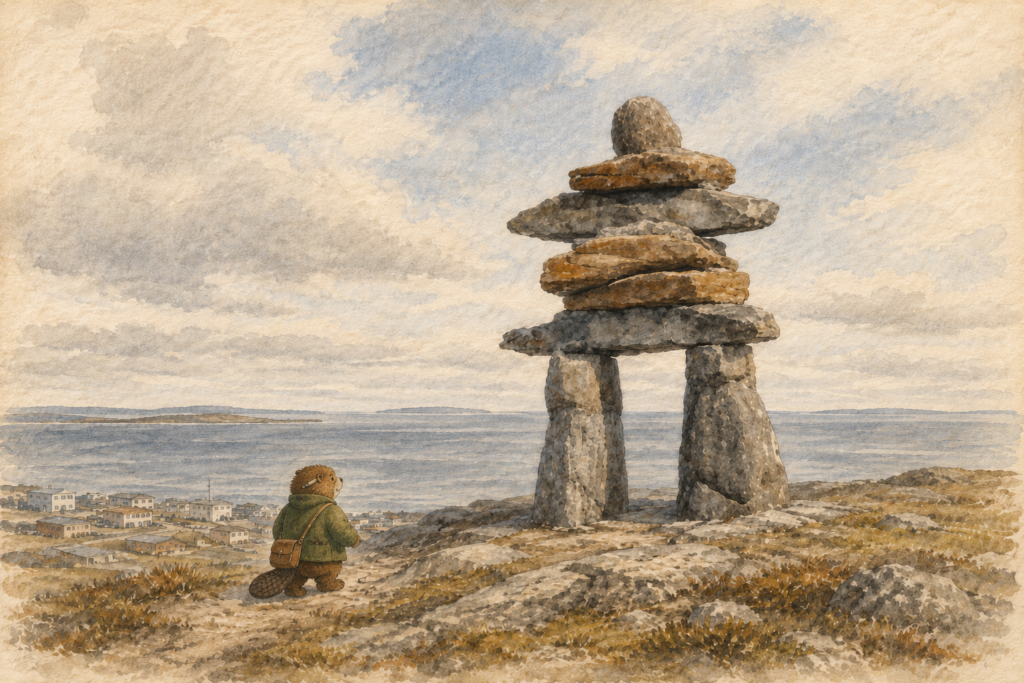
Cousin Rankin Inlet sits on the western shore of Hudson Bay. There is no highway to it. You arrive by air or by sea.
On the hill above the harbour stands an inuksuk, tall enough to be seen from far out on the water.
“It says only one thing,” Cousin Rankin Inlet told me. “Someone found the way before you.”
She looked toward the bay.
“And you don’t have to find your way alone.”
Three people built the cirque: a fire-breather, a businessman, and a man willing to walk ninety kilometres on stilts.
✦ ✦ ✦
Cousin Duncan set her cup down.
“So what do you think?” she said.
The hockey stick on the wall behind us was built in 1985 for Expo 86. Two hundred and five feet long. When the fair closed, the province did not know what to do with it. Duncan asked for it. The town raised the money to move it and hang it here in 1988.
“The town didn’t need a hockey stick,” she said. “But the country did. Duncan was the only place that put up its hand.“
✦ ✦ ✦
I said I thought I had figured it out.
“Go on.”
“I don’t think those are monuments.”
“No?”
“They’re thank-you notes.”
She laughed. “To whom?”
“To whoever grew the potatoes. To whoever baked the perogies. To whoever fished the squid. To whoever designed the loonie. Who kept telling the stories.”
“To grandparents,” she said. “To neighbours. To places.”
Grandfather Henri used to say that monuments tell you what a country admires. I think he was almost right.
Ours don’t celebrate power. They celebrate affection.
Every small town has something it wants the rest of Canada to remember.
Sometimes the easiest way is simply to make it impossible to miss.
✦ ✦ ✦
Across the parking lot, another family was taking exactly the same photograph thousands of families had taken before them.
Cousin Duncan raised her cup. I raised mine.
Tomorrow I drive home. The giant things will still be there, quietly reminding the rest of us what matters.
(undated, sometime in the 1970s)
“There is no such thing as a small hockey town.”
— Henri

June 24 — Miminegash, Prince Edward Island (population 148)
Abby Hustler, fourteenth overall to the PWHL’s Hamilton club. First Islander ever drafted into the Professional Women’s Hockey League. On Abby Day, the village unveiled a new welcome sign, threw a fire-hall pancake breakfast, ran a parade, held a meet-and-greet, and lit off fireworks in the evening. The crowd was many times the size of the town itself.
June 26 — Whitehorse, Yukon
Gavin McKenna, eighteen years old, of the Tr’ondëk Hwëch’in First Nation. First overall in the NHL draft to the Toronto Maple Leafs. First Yukoner ever taken first overall. Hockey Yukon packed Takhini Arena for a watch party — hundreds of families, sponsorships pouring in beyond what the night needed, the extra money going to Yukon Special Olympics. McKenna still comes home each summer to run hockey camps for local kids.
Grandfather Henri was right.

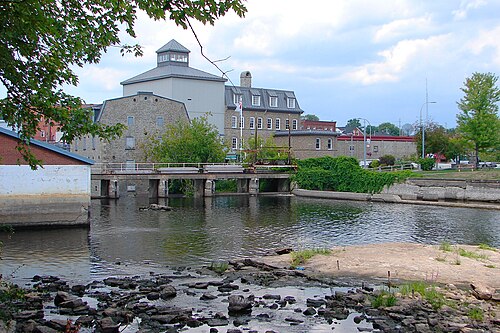
→ Cousin Smiths Falls (Ontario) sent a photo from the Railway Museum. On Father’s Day, grandmasters strongman Tim Norris pulled a CP Rail caboose weighing more than 60,000 pounds across the museum yard. He had aimed for 15 feet. He hauled it 83. What organizers called a world record, weeks after he returned from the World Strength Games in Utah. The pull was a fundraiser for the museum’s roof. Cousin Smiths Falls says the museum has a new roof now.
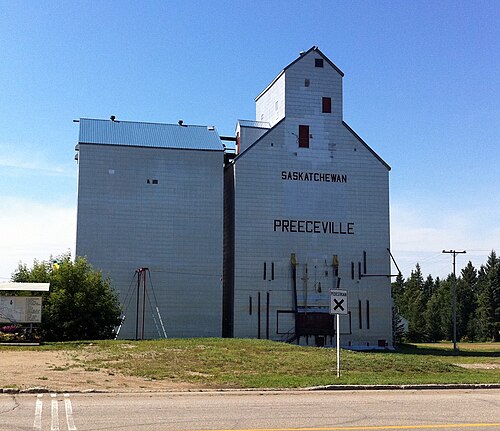
→ Cousin Preeceville (Saskatchewan) called about bread. On July 9, during Old Home Week, the town held a Homemade Chili and Clay Oven Bread Day — live music, chili, bread baked in a traditional clay oven. Down the highway in Veregin, the Doukhobor Heritage Museum served its popular Bellini Brunch. Cousin Preeceville says the clay oven has been going all summer.
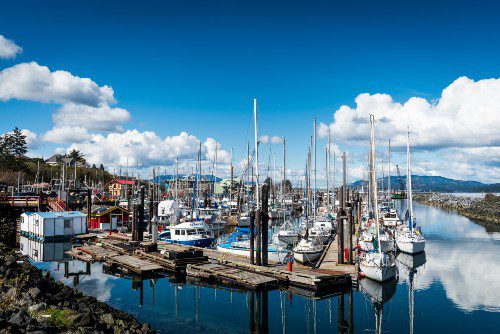
→ Cousin Campbell River (British Columbia) sent a whale-watching log. Bigg’s — the transient killer whales — have been socializing through the Discovery Islands in recent days. Several family groups were logged on July 4 alone. Meanwhile the coast’s famous summer bald-eagle concentrations pull wildlife watchers north by the boatload. Campbell River calls itself the Salmon Capital of the World. Cousin Campbell River says some weeks, the real work is simpler than fishing — a front-row seat at the edge of the wild.
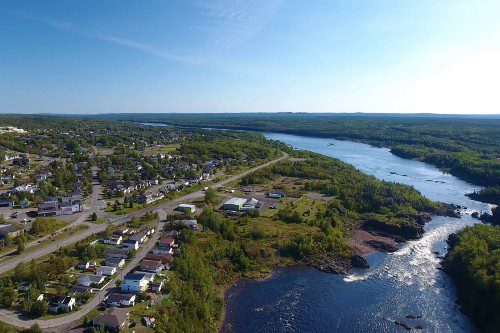
→ Cousin Grand Falls-Windsor (Newfoundland and Labrador) wrote about the salmon. The Exploits Valley Salmon Festival opens July 9 — a week of music and community built around the Atlantic salmon that made the Exploits River famous, and a concert lineup big enough to draw crowds from across the island. Grand Falls-Windsor grew up around a pulp mill on the river. The mill era has passed. The salmon are still coming. Cousin Grand Falls-Windsor says the town throws its biggest party of the year in honour of a fish.
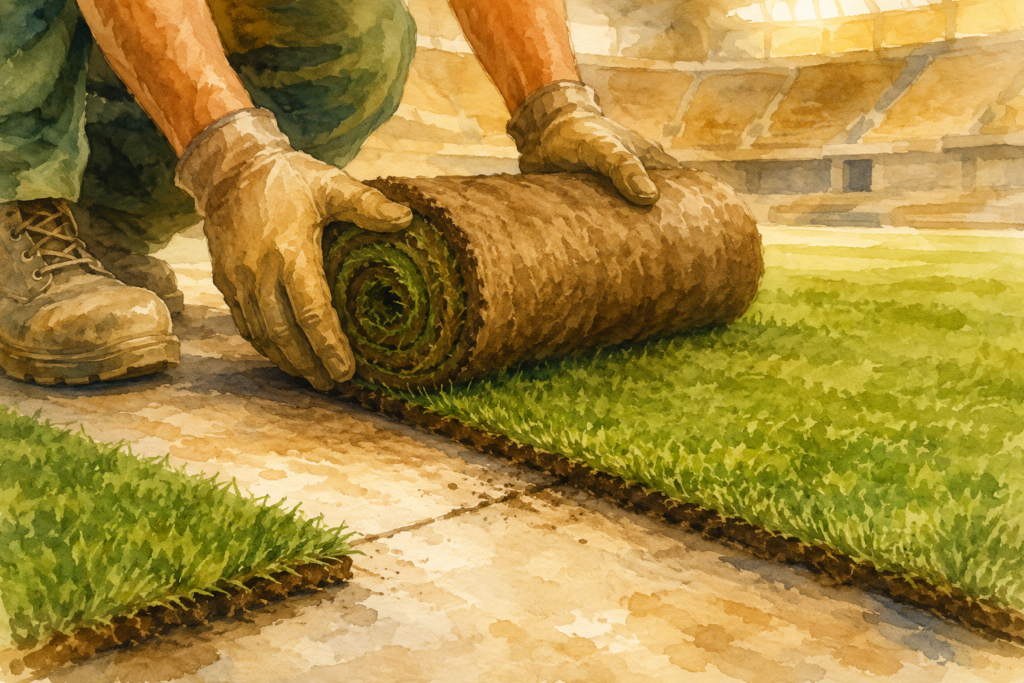
As Canada co-hosted the FIFA World Cup, the grass under the biggest matches in Vancouver was grown by a man from a PEI hamlet of 269.
Cardigan native Donald Campbell was project manager for the natural-grass pitch at BC Place — sod nurtured for a full year at an Abbotsford farm before being harvested and laid in May.
“It was exhausting and stressful at times,” Campbell said. “But it was amazing to see it in use.”
As the country hosts the World Cup, an Islander from a hamlet literally laid the groundwork.
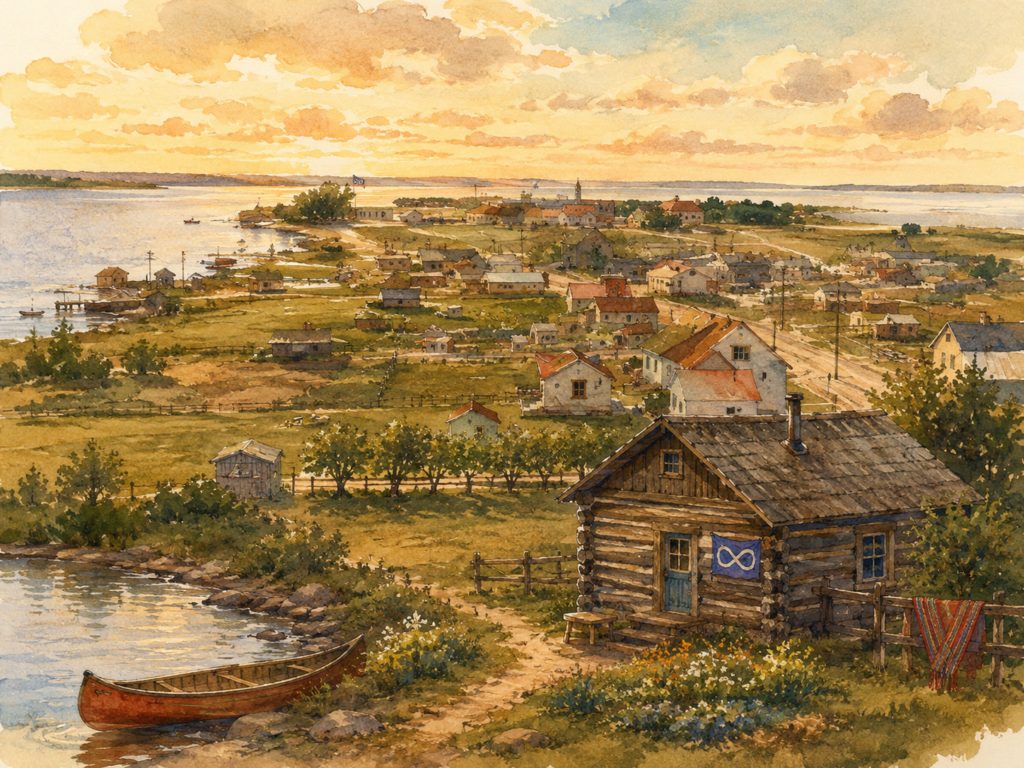
June 25–28 · the 36th edition
From July 3 to 8, the village of about 1,400 people at the crossroads of the great northern fur-trade routes opened a week of festivities for its quarter-millennium. Michif and Cree storytelling. Fiddling. Canoe racing on the lake. Nightly drone shows. A Treaty 10 re-enactment. A $25,000 square-dancing and jigging contest that drew home people from as far away as B.C. and Quebec.
We missed the week itself.
Which may be a better time to go.
A village of 1,400 people does not stay itself with a thousand visitors on the dock. To feel Île-à-la-Crosse the way it has been felt for 250 years, you want the boat, the water, and the people who stayed.
Île-à-la-Crosse is Saskatchewan’s second-oldest permanent settlement, founded in 1776 by French voyageurs who named it after watching a lacrosse-like game played on the ice. The birthplace of Louis Riel Sr., father of the Métis leader. The site, from an 1846 mission, of some of the earliest schools and medicine west of Winnipeg. Continuously inhabited by Métis families ever since.
Larry Gardiner has lived his whole life on the lake. When a reporter asked him about the anniversary, he answered in seven words. “We’re resilient. This town’s been here a long time.”
Drive to Île-à-la-Crosse for the water. Drive for the history. Drive because the boat route is still there, and so are the fish and the bannock and the tea, the way visitors were once greeted when they came across the water. And so is the lake that has been holding this village together for 250 years.

A couple of weeks ago, in the Canada Day letter, I stopped in Perth to stand beside the replica of the twenty-two-thousand-pound wheel of cheese — the one that twelve cheese-makers built from the milk of ten thousand cows in 1893, shipped to the Chicago World’s Fair, and dropped clean through the floor of the railcar on the way there.
I thought that was the whole story of Perth.
But the Perth mail kept coming.
Two of you wrote to tell me I had missed things.
→ Ian Lloyd wrote on Facebook:
“Lovely moments across Canada. You could have got a two-fer in Perth. The Mammoth Cheese and Judge Matheson’s role in developing the Canadian flag.”
→ Joseph Nieforth added:
“Not to mention the ship’s surgeon on the Nimrod expedition by Ernest Shackleton to Antarctica was from Perth. Dr. W.A.R. Michell.”
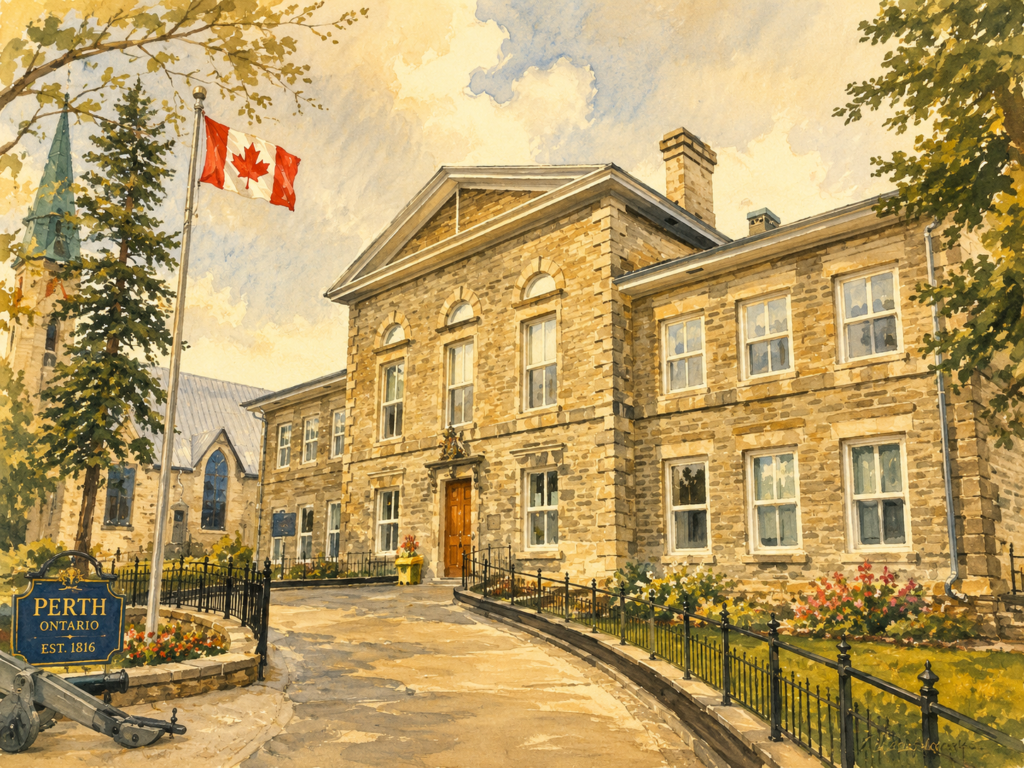
Ian was right. There is a judge who sat on the Perth bench for twenty years — starting in 1969 — and the flag that flew over the courthouse where he heard cases every day was the one he had himself designed. His name was John Ross Matheson. When the country was arguing over what a Canadian flag should look like, it was Matheson who fought through committee for the single red leaf between two red bars.
The one that flies over your post office and mine.
Read the full profile: John Ross Matheson | Canada’s Flag Architect →
✦ ✦ ✦
Joseph was right too. A doctor was born in Perth in 1879, trained in Toronto and London, and took work as a ship’s surgeon on the west coast of Africa. That experience is what got Ernest Shackleton’s attention. In 1908 he sailed south with Shackleton toward the pole. His name was Rupert Michell.
When Shackleton later came to Canada on his own speaking tour, he made a point of meeting Michell in person.
Read the full profile: Rupert Michell | Antarctic Surgeon →
✦ ✦ ✦
So there it is. One small town. A cheese that went to a World’s Fair, a flag that went up every pole in the country, and a man who went as far south as a person could go.
This is the thing about small towns, and it took two strangers writing to a beaver to remind me of it. You think you’ve seen the whole of a place. And then the people who actually live there tap you on the shoulder. There’s more. There’s always more.
Grandfather Henri used to say the important things in a town are never kept in the museum. They’re kept in the people — in what they remember, and in whether anyone thinks to ask.
Ian thought to tell me. Joseph thought to tell me. Perth now has three stories on 1000towns instead of one — both new profiles live on the Perth town page and in the People of Small Towns section.
You can read them now.
So here is my standing invitation, to Perth and to every town I’ve written about and gotten only half right. If I’ve missed something — and I always have — tell me. That’s how these letters get made. Not by me. By you.
— Castor
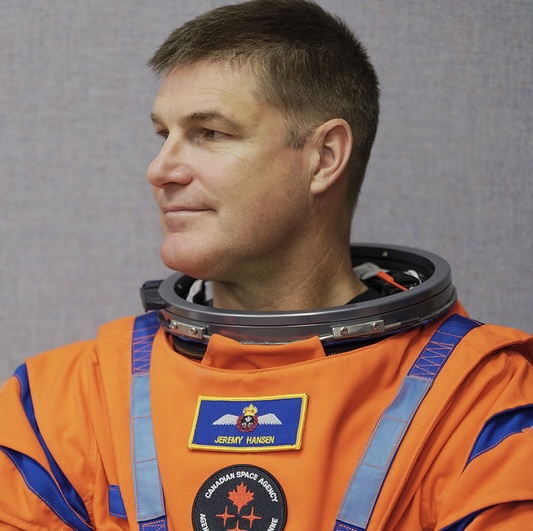
The Ingersoll Public Library has a new display. Since it went up in April, the space books next to it have not stayed on the shelves.
The astronaut in the display is named Jeremy Hansen.
Hansen grew up on a farm outside Ailsa Craig, in southwestern Ontario. Dairy cows. Early mornings. Quiet Sundays. At twelve, he joined the 614 Royal Canadian Air Cadets. At sixteen, he had his glider pilot wings.
His family moved to Ingersoll for high school. He graduated from Ingersoll District Collegiate Institute.
From cadets he went to the Royal Military College of Canada. Then the Royal Canadian Air Force, as a CF-18 fighter pilot. In 2009 the Canadian Space Agency called.
Fourteen years of training followed.
The mission was Artemis II. On April 1, 2026, Hansen and three American colleagues launched. On April 6, they flew past the far side of the Moon and looped back home. 252,756 miles. Farther than any human being had ever been.
No one from outside the United States had ever gone that far.
They splashed down on April 10.
In June, Hansen came home to Ingersoll.
The library display is still up. Kids come every week.
CBC News put a headline on the story that stuck: “From our little town to the moon.”
Cousin Ingersoll says Mayor Brian Petrie can’t quite believe it either.
“It’s still a little unbelievable that someone from our town is at this level.”
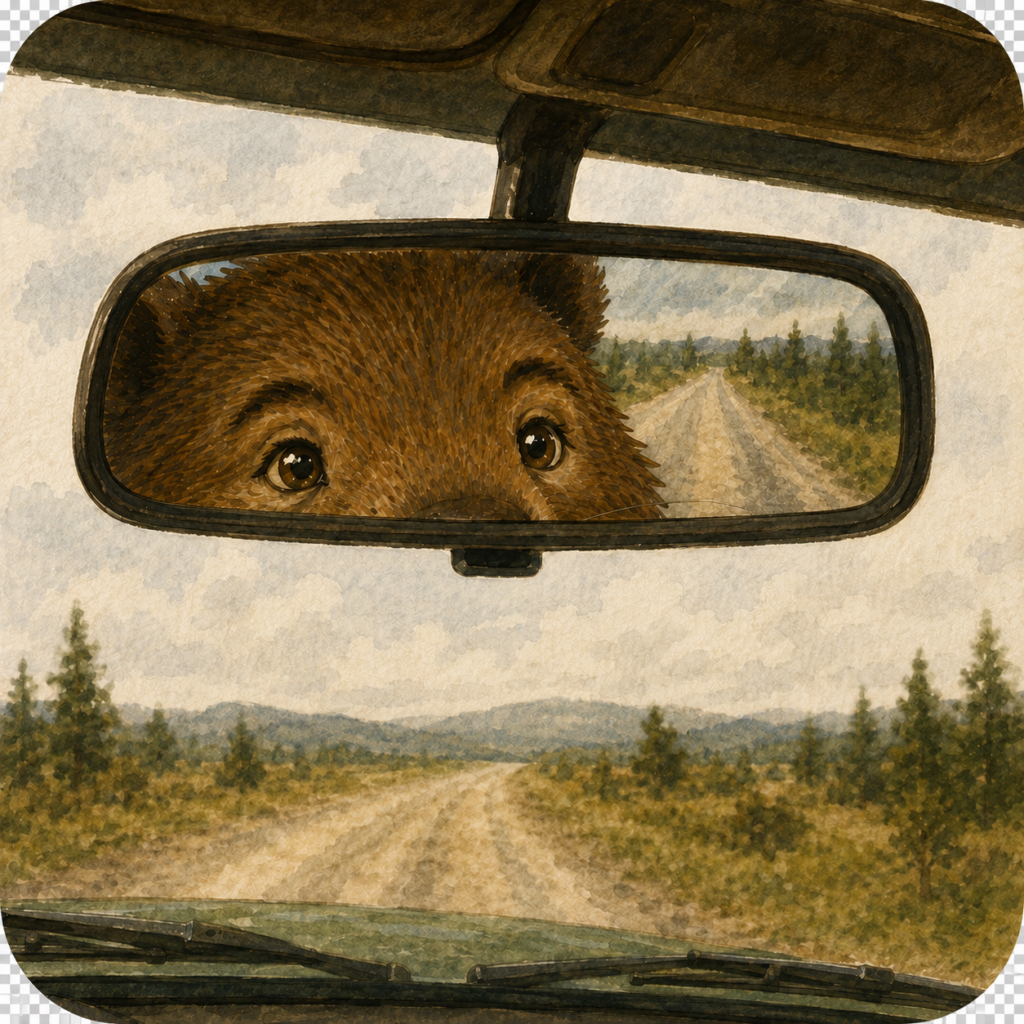
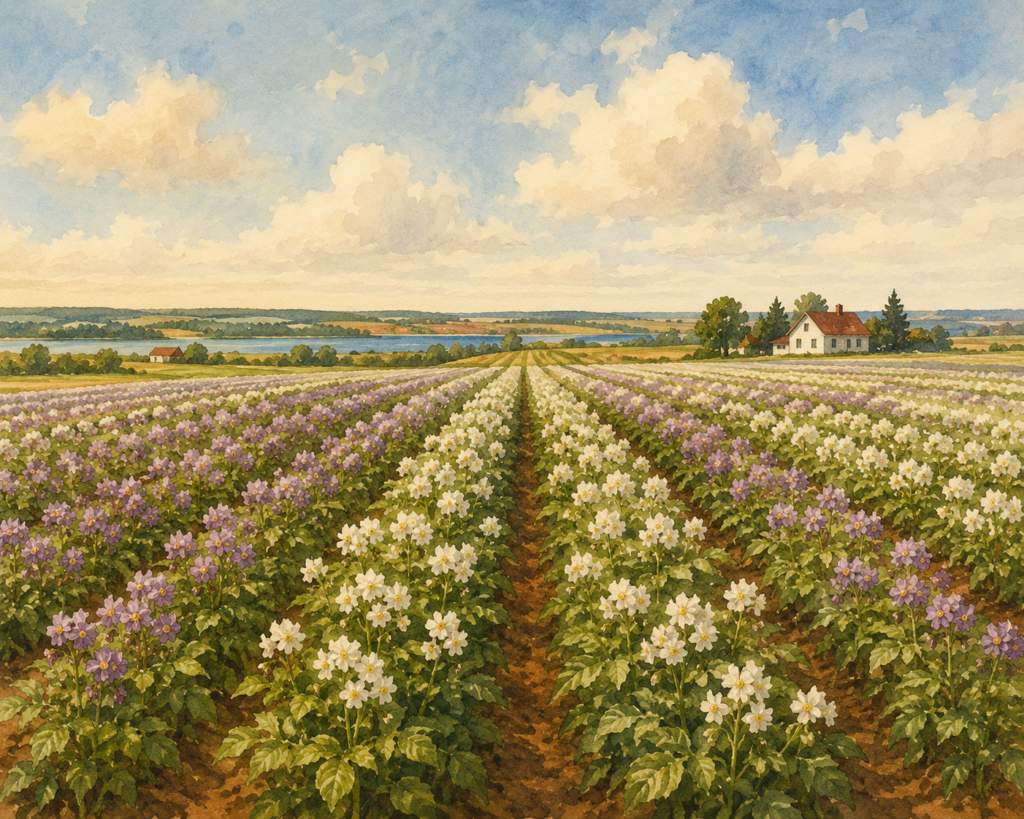
Cousin O’Leary called last summer, in the middle of July. She said the potato fields on the western side of Prince Edward Island go white and purple for one week in July, when the plants flower. Most of the year, the fields are green. For those seven days, they are not.
The town of O’Leary times its PEI Potato Blossom Festival to the flowering week. This year it runs July 13 to 19. The Canadian Potato Museum is in town. So is a giant potato sculpture at the museum entrance.
Cousin O’Leary says most people do not know that potato plants blossom. She says the fields go white first, then purple. She says the wind moves through them like they are breathing.
Last week I told you I was standing on an old air base on a Manitoba prairie, forty-three summers after an Air Canada Boeing 767 that had run out of fuel over northwestern Ontario glided down and landed on the disused runway. Nobody was hurt.
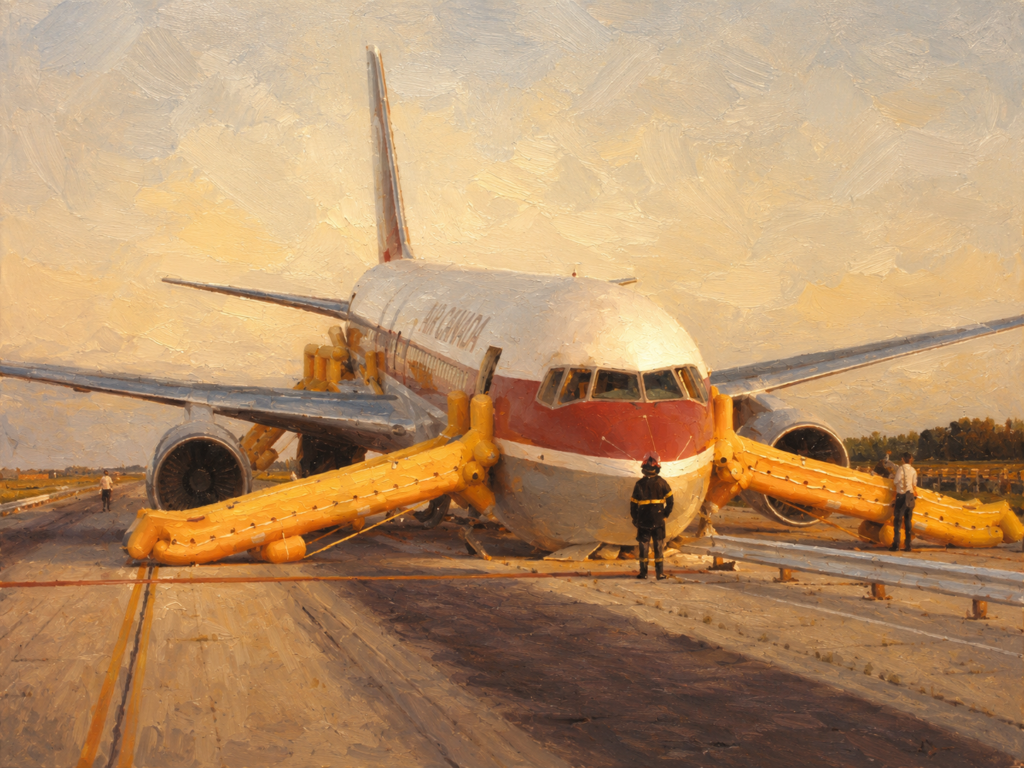
That town was Gimli, Manitoba.
Gimli sits on the west shore of Lake Winnipeg. It was founded in 1875 by settlers from Iceland — the first permanent Icelandic settlement in North America. The Icelandic Festival of Manitoba still runs every August, and the New Iceland Heritage Museum is downtown. Above the harbour stands the Gimli Viking, a fifteen-foot statue erected in 1967 for Canada’s centennial.
On July 23, 1983 — forty-three years ago next week — a jetliner without engines glided in from the sky. The pilots landed it on a runway that had been closed since 1971. A drag race was happening on that same runway when the plane arrived. Nobody was hurt.
Cousin Gimli says the town remembers both the Viking and the plane. She says the Viking gets the parades. The plane gets the coffee-shop stories.
The picnic tables in Charles Hoey Park are quiet now. 39 Days of July still has twenty-two days to run without me. Grandfather Henri’s notebook is on the passenger seat where it has always been.
I’ll write next week from somewhere new.
Got a town in mind? Write to me. I’ll ask the cousin there.
Yours in maple,

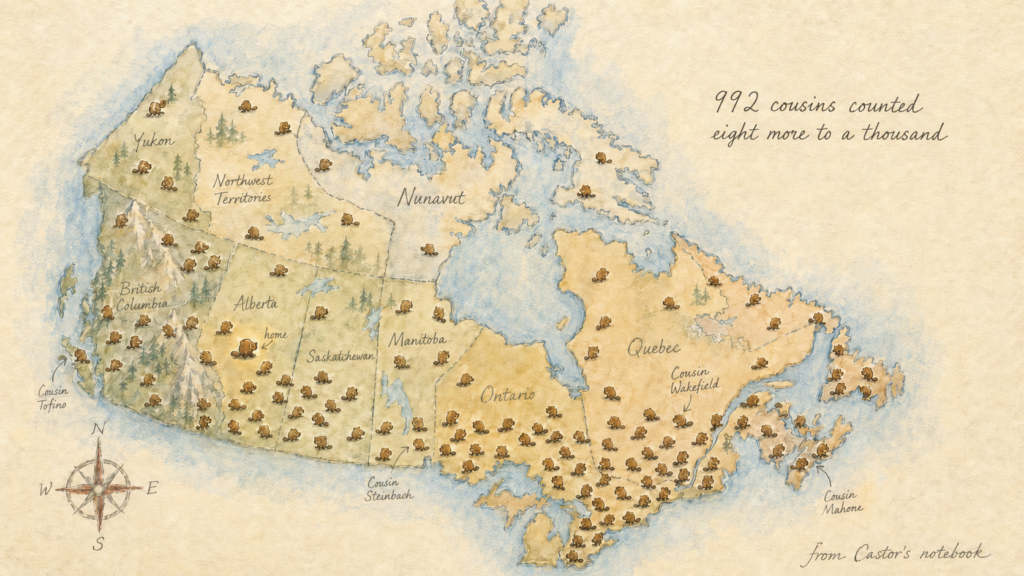
P.S. 992 cousins counted. Eight more to a thousand.
More from the road this week
Castor, Alberta — population 876, where the streams east of Red Deer kept the family in dam-builders for generations.