
Castor's Letter · No. 15
→ 150 years ago, two small Ontario towns changed the way the world talks. → A hundred-year-old bear from a small Ontario town. → Alice Munro’s garden, and how a small town remembers its giants. → Nine festivals across the country in one summer week.
By Castor · Monday, August 10, 2026 · 11 min read
Towns Castor mentioned this week
The watercolour illustrations in Castor’s Letters are made with a mix of original photography, editorial design, and AI illustration tools, curated by our team. Words and editorial decisions are entirely human.

Canada has always had more distance than people.
Every generation of Canadians has invented a new way to reach across it. Rail brought Halifax and Vancouver into the same country. Radio brought the outports and the prairie farmhouses into the same conversation. The telephone let a father in one small Ontario town read a poem to his son in another.
We are still doing it. This morning somebody in Fort McMurray FaceTimed his mother in Charlottetown. Somebody in Whitehorse texted her sister in Corner Brook. Somebody in Iqaluit sent a voice memo to a friend in Kelowna.
Whatever the next device turns out to be, it will be a Canadian problem before it is anyone else’s.
If there is a town you have been wondering about, write to Castor. He will ask his cousin there. Happy discoveries. — The 1000towns team
‘Dear 1000towns —
Every time we answer a phone, we continue a conversation that began between two small Ontario towns one hundred and fifty years ago.
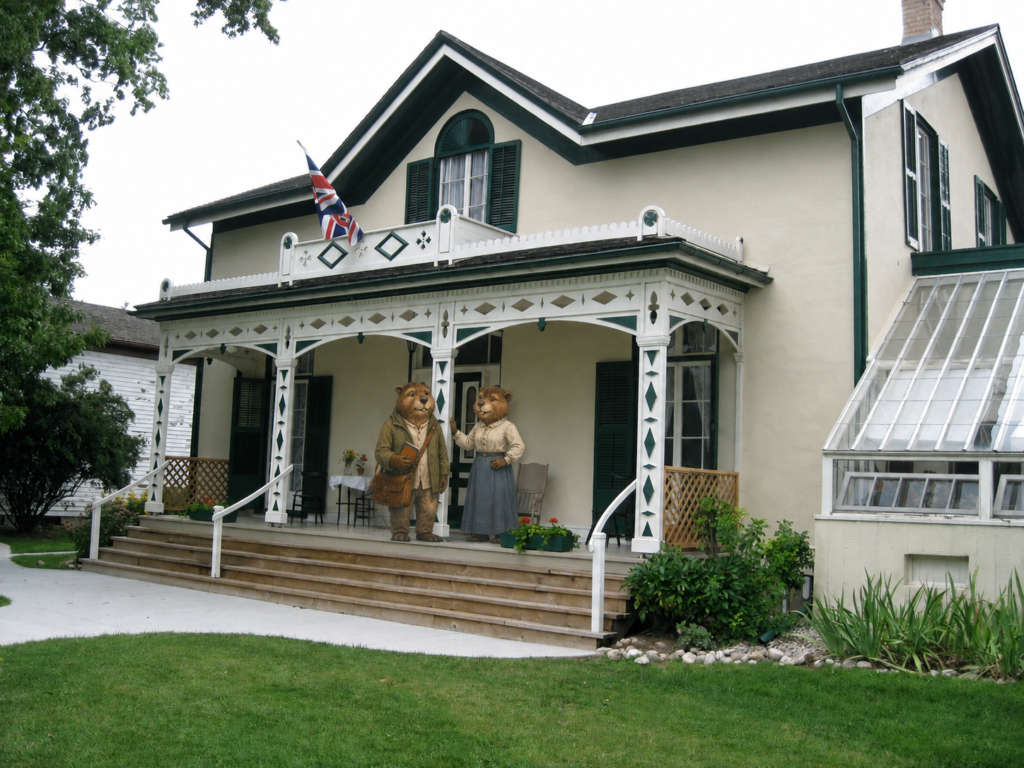
I am at the Bell Homestead on Tutela Heights, looking out at the Grand River, and I have just called Cousin Paris.
She lives thirteen kilometres upriver. She picked up on the first ring.
✦ ✦ ✦
Cousin Brantford had met me at the front gate an hour before. She took me inside.
The parlour was set up like a party. Kerosene lamps. A piano bench. A book of poetry open on a music stand. A wooden telephone box, brass horn attached, sat on the mantel.
“A hundred and fifty years ago tomorrow night,” Cousin Brantford said, “this room was full of people.”
She named the ones we know. Alexander Graham Bell’s father Alexander Melville Bell. His uncle. Neighbours from Tutela Heights.
“They took turns,” she said. “Reciting poetry into that horn. Singing. Someone played the harmonica.”
“And on the other end?”
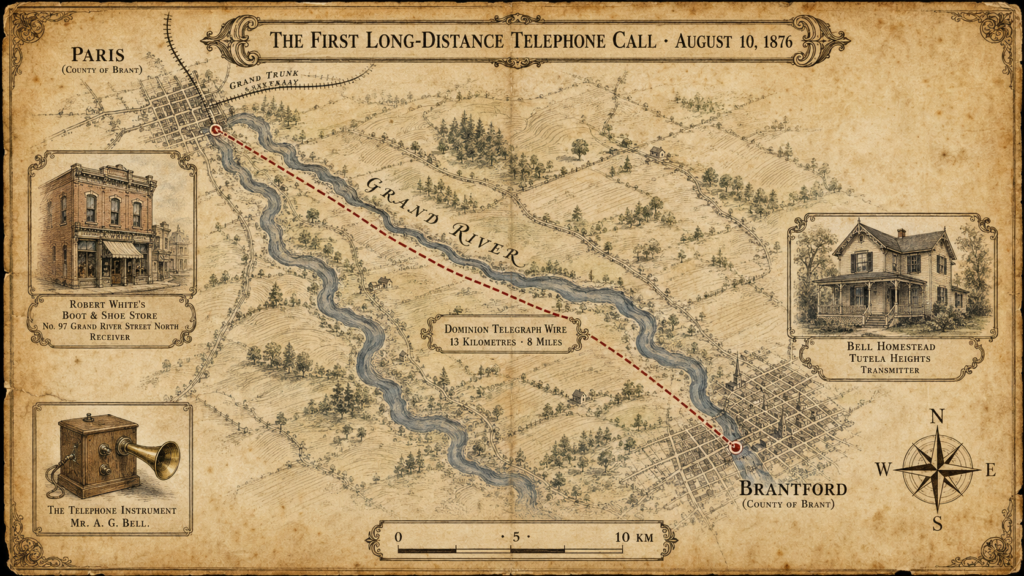
“Thirteen kilometres up the Grand River. In a boot shop in Paris.”
“Only thirteen?”
She smiled.
“At the time, it might as well have been the moon.”
Because it might as well have been. Before that evening, no human voice had ever travelled that far. If someone wasn’t in the room with you, they might as well have been beyond the horizon. You wrote them a letter. You waited three weeks. You waited three months. You never quite knew if they were all right.
✦ ✦ ✦
Five months earlier, in a Boston laboratory, Alexander Graham Bell had transmitted the first human voice through a wire. That voice had travelled only across a room.
But in August 1876, in a boot shop in Paris, Bell himself put a receiver to his ear and heard his father, thirteen kilometres away, reading a poem.
And Canada — and the world — got a little smaller.
✦ ✦ ✦
“A year later,” Cousin Brantford said, “Alexander gave his father the Canadian patents. Alexander Melville began leasing telephones out of this parlour. That was the first Canadian telephone company.”
“From this parlour?”
“From this parlour. It’s called Bell Canada now. Many Canadians still pay it a monthly bill. The first Canadian telephones were built up the road too — a friend of Alexander’s had a factory on Colborne Street.”
✦ ✦ ✦
“May I?”
Cousin Brantford nodded.
I lifted the receiver. Somewhere in Paris, Cousin Paris picked up.
“Cousin Brantford texted you?”
“She did. I’m at the same building as Mister Bell was — ninety-seven Grand River Street North. It was Robert White’s Boot Shop in 1876. It’s an Italian pizzeria now. Same brick front. The same window I hope. Plaque on the wall. I’m sitting where Bell sat, with pizza.”
“What does the plaque say?”
She stepped outside. I heard her chair slide, a door, her footsteps on the pavement. Then her voice again, closer to something metal.
“On August 10, 1876, Alexander Graham Bell received in this building the world’s first successful long-distance telephone call. The transmission originated in Brantford, eight miles distant, over a telegraph wire.”
“What does it feel like,” I asked, “to sit in that window on the night before the hundred-and-fiftieth anniversary of a phone call?”
She thought about it.
“Ordinary,” she said. “That’s the thing about it. It was a working boot shop. Someone probably came in for laces halfway through history. Now I am eating pizza.”
Behind her, I could hear a car door close and someone calling goodbye from the sidewalk. Grand River Street was still doing what main streets do: letting history happen without closing for it.
✦ ✦ ✦
Cousin Brantford went to make tea.
I sat down on the settee under the parlour window. The last light was going out of the sky over the Grand River.
Grandfather Henri used to say an invention changes the world twice. Once when somebody makes it. Again when neighbours find a use for it.
I closed my eyes.
✦ ✦ ✦
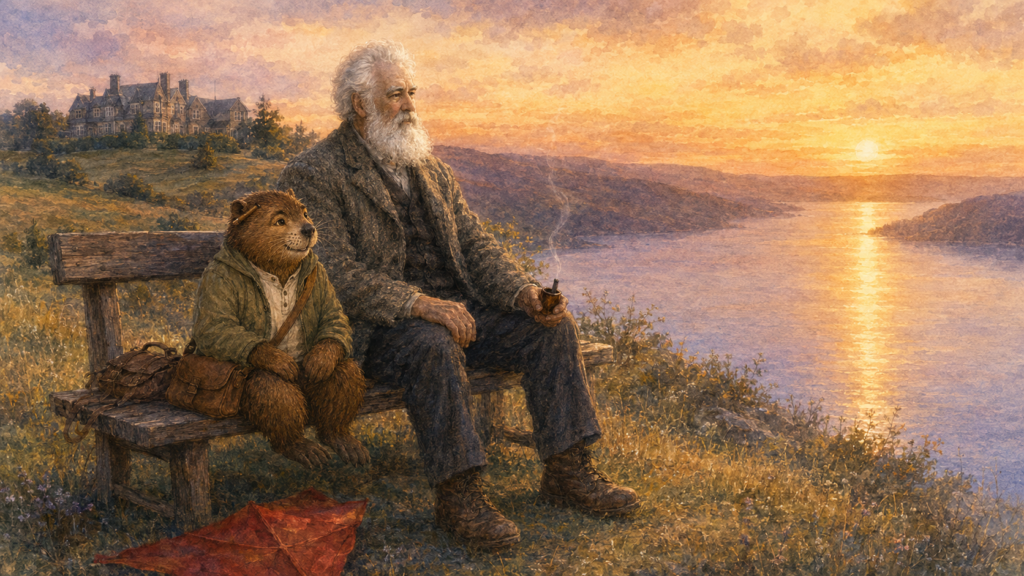
I opened them on a high headland above Bras d’Or Lake, in Nova Scotia — where Bell had spent the last thirty years of his life.
The air smelled of salt and pine and the faint sweet smoke of pipe tobacco. An old man was sitting on a wooden bench near the water, wrapped in a heavy grey tweed coat despite the August evening. Long white beard. Dark, steady eyes. A pipe resting between his knuckles.
Beside him on the grass, folded into a neat square, was a piece of red silk from one of his giant kites.
“You’re up late, Mr. Bell,” I said.
“The night is the only time the world stops making noise, beaver.”
He tapped his pipe against his boot. He hadn’t turned to look at me. “You were in the parlour tonight.”
“Yes.”
He smiled into his beard.
“That night,” he said, “I sat at a bootmaker’s counter in Paris, holding a receiver to my ear. When I heard my father’s voice through that wire, it was like the room had grown. Like the walls had moved thirteen kilometres, and everybody I loved was still inside.”
“Do people still call each other?”
“Yes.”
“What do they say?”
“Mostly the same things. I miss you. I’m here. Did you get home?”
He took a slow breath of the lake air and nodded.
“Then it worked.” He turned back to the water.
“People think I invented a machine, beaver. All I did was shorten the Grand River.”
✦ ✦ ✦
I opened my eyes.
Cousin Brantford was setting a cup of tea on the table beside me.
“You were only asleep for a minute,” she said.
✦ ✦ ✦
Bell didn’t really invent long distance.
He invented absence becoming smaller.
Canada has always contained more distance than people. Rivers, forests, winter roads, families scattered farther than they meant to go. We have spent much of our history finding ways to remain neighbours anyway.
Two towns. Thirteen kilometres. One hundred and fifty summers.
The country’s first long-distance call was one small town calling another.
One hundred and fifty years later, we still are.
— Castor

His real work was teaching deaf children to speak. His mother Eliza had been deaf since childhood. His wife Mabel had lost her hearing to scarlet fever at five. He communicated with both of them for most of his life through touch — tracing letters into their palms, feeling for the vibration of a voice in their throats.
The telephone came out of a side experiment that was supposed to help pay for the teaching. It got away from him.
Everything you know him for was a byproduct of the two people he loved most.
He was born in Edinburgh in 1847. His father invented Visible Speech — the first attempt to write down every human sound. Alexander adapted it for the deaf. The work brought him to Boston in 1871, to a school for the deaf and to a fifteen-year-old student named Mabel Hubbard. It also brought his family, the year before, to a small Ontario town called Brantford, where he insisted — until his last summer — that the idea of the telephone had come to him on the porch above the Grand River.
Fame and money arrived in his early thirties. He did not particularly want either.
When he could afford to leave, he chose another small Canadian town. A village of eight hundred people on the shore of Bras d’Or Lake, in Cape Breton, because the hills reminded him of the Scottish coast he had left as a child. He spent the last thirty years of his life there.
Baddeck is where he did most of his other inventing — the Silver Dart, the HD-4 hydrofoil, giant tetrahedral kites, a metal-detecting probe to find the bullet in a wounded American president, an iron lung, a refined phonograph, and a herd of experimental sheep. He also helped found the National Geographic Society and served as its second president.
He did all of it from a headland where the trains didn’t stop.
He was buried on that headland in August 1922. During his funeral, at his family’s request, every telephone in North America went silent for one minute. Mabel followed him five months later. Their marker faces the lake they built their life on.
* * *
He built a machine that carried voices to people who could hear.
He spent his life trying to reach the ones who couldn’t.
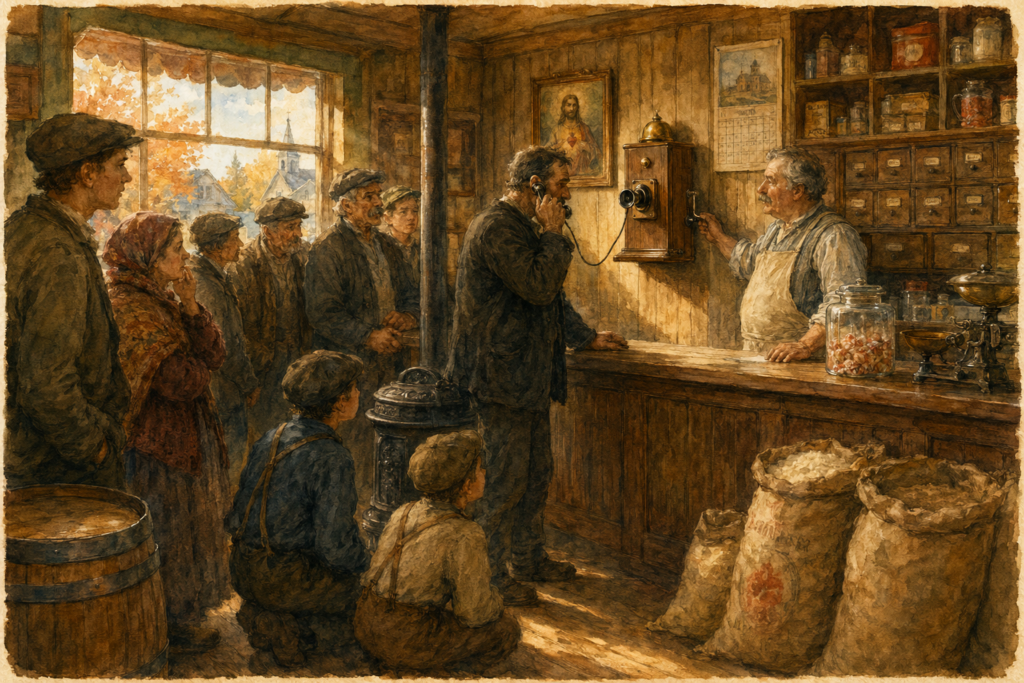
It was 1911. He was in his fifties. He was standing in Monsieur Fournier’s general store on a Saturday morning when the wire men arrived to install the village’s first telephone. They mounted a wooden box on the wall behind the counter. A small brass bell on top. A crank on the side.
Monsieur Fournier turned the crank and reached the operator in Trois-Rivières. Then he reached his brother in Sherbrooke. Then he handed the receiver to my grandfather, who reached his brother in Montreal.
There was a small crowd in the store. Everyone leaning against the flour barrels, listening.
My grandfather spoke into the box. Then he was quiet for a long time. Then he laughed. Then he handed the receiver back to Monsieur Fournier, and he sat down on the empty apple crate, and he cried a little.
He said his brother’s voice was the same as it had been the last time they had spoken, on the wharf at Sorel, in 1893.
Eighteen years. Two provinces. Ten seconds of copper wire and a wooden box.
That is when he understood what Mr. Bell had made, he told me later. Not the invention. The reunion.
I was six years old the day he told me. I did not fully understand.
I do now. I have a telephone in my house. My son has one on his desk in Montreal. My daughter has one in her kitchen in Chicoutimi. I call her every Sunday.
The wooden box still sits on the wall in Monsieur Fournier’s old store. It is not connected any more. But when the last shopkeeper’s daughter cleaned up in 1953, she left it there. She said it belonged.
— Henri

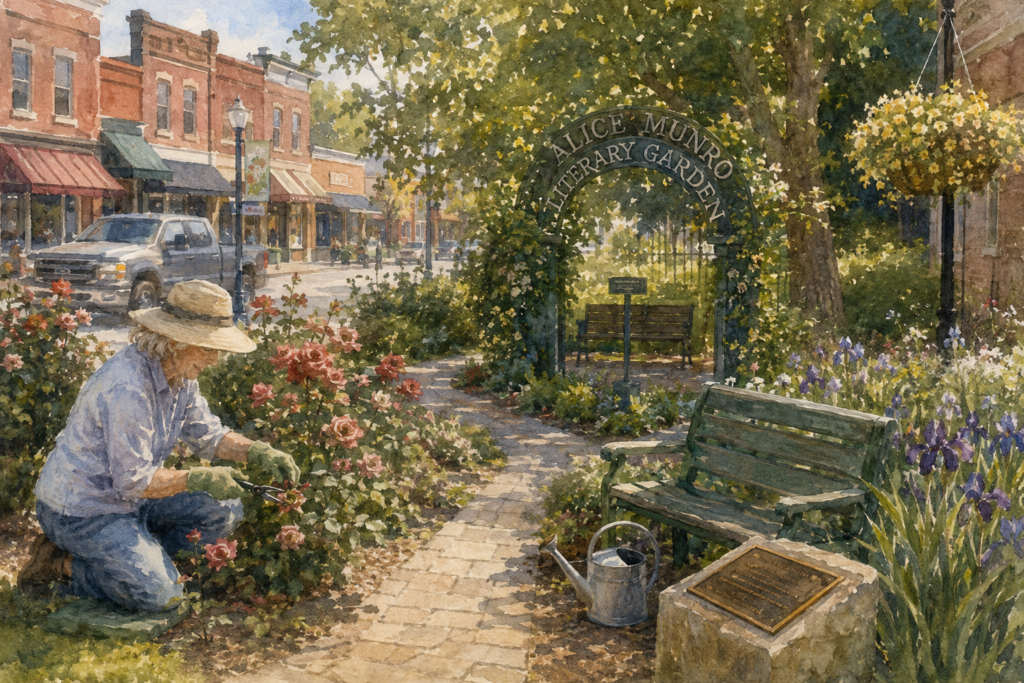
The Alice Munro Literary Garden holds roses, irises, and a low wooden bench, tended for years by the Wingham Horticultural Society. It was planted after Munro won the Nobel Prize in 2013. The Society is celebrating its sixtieth anniversary this summer — sixty years of volunteers showing up on Tuesdays with a watering can.
Last month, the municipality proposed moving the garden to the downtown library. The Horticultural Society learned about it in the newspaper. There were meetings. Apologies. The garden’s future is unsettled.
I went up to look at it.
* * *
Alice Munro spent her whole life writing about small towns.
For sixty years she wrote about the same handful of streets in southwestern Ontario. She called the town Jubilee. She called it Hanratty. She called it Walley. She called it Dalgleish. She never really left Wingham, even when she moved away.
Not everyone in Wingham was flattered. Munro wrote unblinking short stories about the smallness of the country places she came from — the meanness, the boredom, the affairs, the closed lives. Some families felt exposed. Some felt caricatured. For decades her hometown was not sure whether to be proud of her or angry with her.
Her Nobel Prize in 2013 changed the tone. The town leaned in. The garden was planted. The Horticultural Society took it on.
* * *
I have spent fifteen years visiting small towns. I have written fourteen letters about them. Alice Munro spent sixty years at this.
She is the closest thing I have to a teacher.
* * *
A town honours its own the way a family honours its own — with awkwardness, and love, and long silences broken by argument. There is no elegant way to remember someone the world called a giant. There is no ceremony large enough. There is no bench small enough.
Munro herself would have written about this beautifully. The awkwardness would have been the story.
Small towns and their giants. Wingham working out what to do with Alice Munro. Brantford working out what to do with Bell for a century and a half. The Bell Homestead is a National Historic Site now — but it took decades of volunteers doing the same slow work the Wingham Horticultural Society is doing right now.
Maybe Wingham figures it out the same way. Volunteers. Patience. Someone deciding to water the garden every Tuesday.
— Castor
White River, Ontario is hosting Winnie’s Hometown Festival — parades, storytelling, a bear-themed craft fair, and live music, all in honour of the hundredth birthday of Winnie-the-Pooh.
The bear stands in a small park beside the Trans-Canada Highway. Paw raised. Transport drivers honk at it without slowing down. They have been doing it for years.
In August 1914, on the platform of the White River station, a young Winnipeg veterinarian named Harry Colebourn was on a train east, on his way to the war. A hunter was selling an orphaned black bear cub. Colebourn paid twenty dollars, named the cub Winnipeg after his home city, and took him all the way to England. When he shipped out for France, he left him at the London Zoo.
A small boy named Christopher Robin Milne used to visit him there. His father wrote a book.
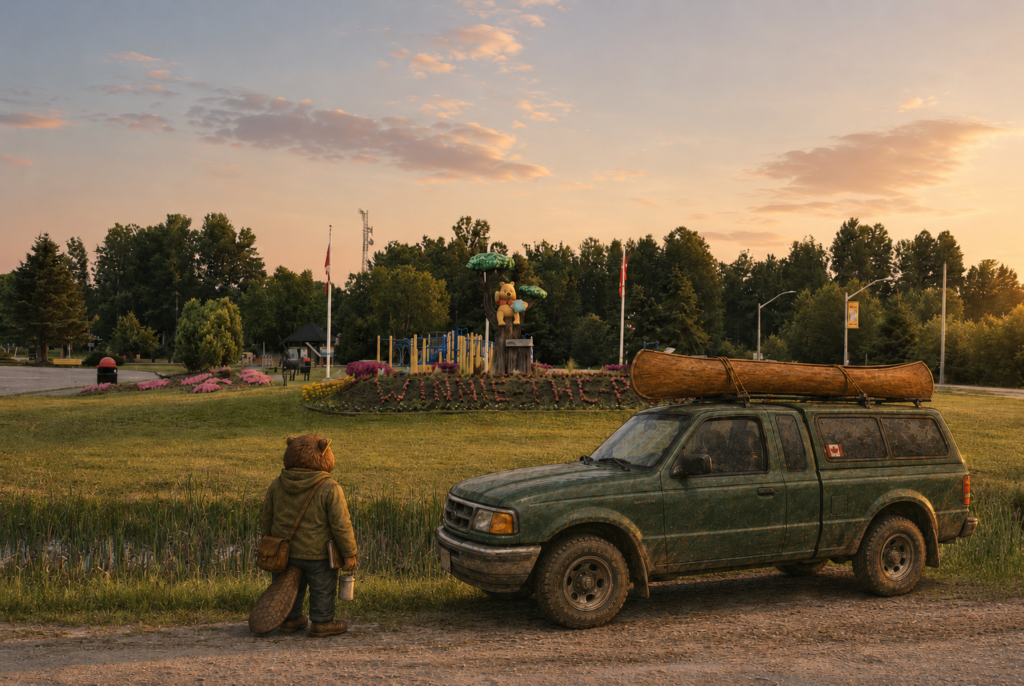
I first wrote from White River in Letter #4 — from the diner, on a Monday morning, listening to the same planning committee prepare this weekend’s festival.
I keep coming back to that town because of the green Methuen copy of the book my mother read to me when I was a kit in Castor, Alberta. Grandfather Henri had read it to her, in the same chair, from the same copy.
If your August needs a bear, drive north.


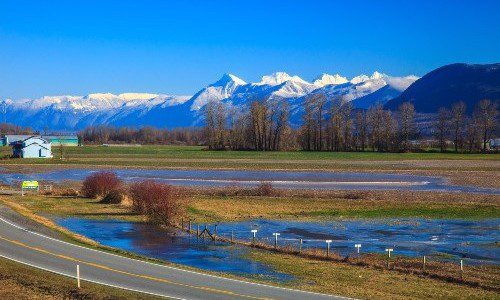
→ Corn-eating contests, corn-shucking contests, and a giant new corn maze. Cousin Chilliwack (British Columbia) sent photos from the Chilliwack Corn Festival at Greendale Acres Farm — the exact middle of the Fraser Valley harvest.
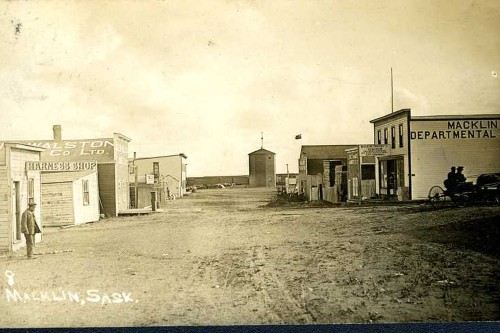
→ Horse anklebones flew across a field all weekend. Cousin Macklin (Saskatchewan) hosted the World Bunnock Championship — a Russian-German folk game where you toss anklebones to knock down opposing “soldiers.” There is exactly one world championship for it. It is here.
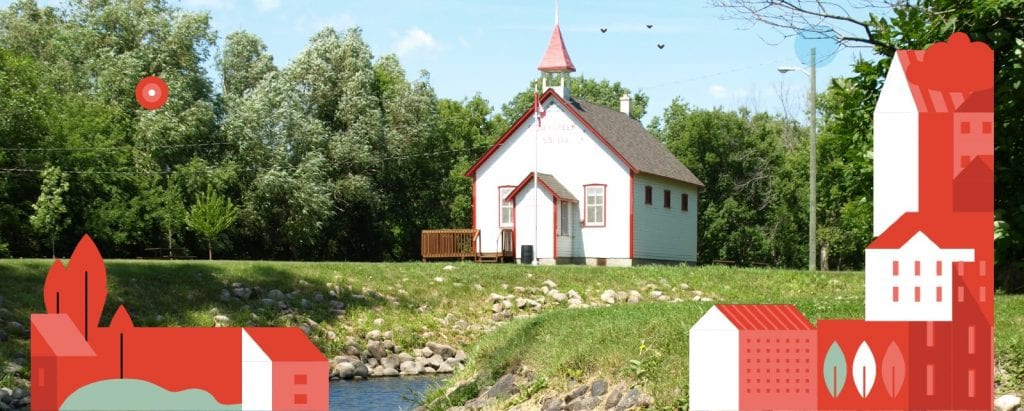
→ Every daylily blooming everywhere the fictional Manawaka once stood. Cousin Neepawa (Manitoba) wrote from the Lily Festival in the self-styled Lily Capital of the World — horse-drawn tours, a fiddling contest, and the whole town in bloom. Margaret Laurence’s hometown, in flower.
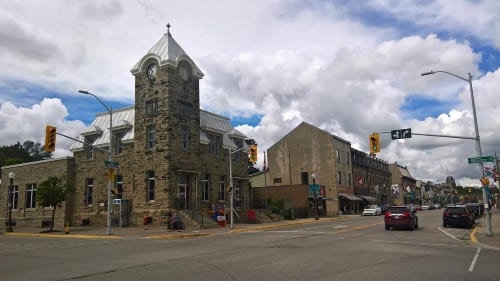
→ Fifty tartans lined the banks of the Grand River. Cousin Fergus (Ontario) wrote from the 81st Fergus Scottish Festival & Highland Games — pipe bands, Highland dancing, and Heavy Events competitions. Bell, whom I visited this week, would have felt at home.
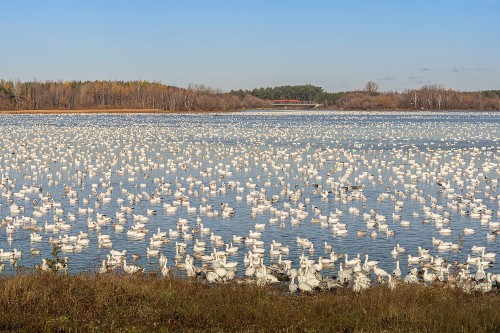
→ 163 years old and still filling the fairground. Cousin Victoriaville (Quebec) wrote from the Exposition agricole de Victoriaville — one of Quebec’s oldest — where livestock competitions share the fairground with the crowd-drawing Festival des hommes forts strongman championship.

→ Racing lawnmowers under stadium lights. Cousin Woodstock (New Brunswick) wrote from Old Home Week at Connell Park — one of the oldest continuously running community celebrations in the Saint John River valley. Parades, fireworks, agricultural shows, a demolition derby — and the summer’s most improbable trophy: the lawnmower race.
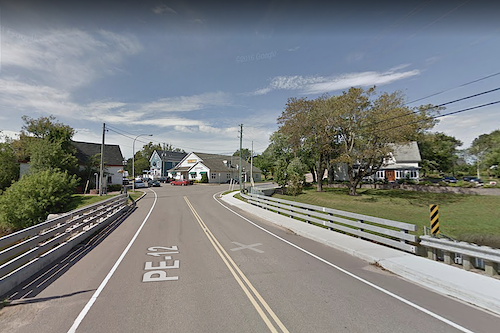
→ The Canadian Oyster Shucking Championship. Cousin Tyne Valley (Prince Edward Island) is a returning correspondent — she wrote us from the same Malpeque Bay wharf in Letter #13. The winner of this weekend’s contest earns the right to represent Canada at the world championships.
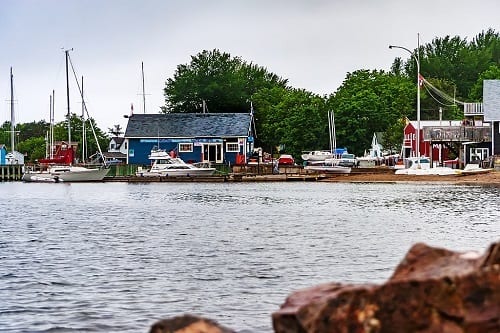
→ Sailboats crossed Canada’s only inland sea all week. Cousin Baddeck (Nova Scotia) sent a photo from the wharf below Beinn Bhreagh — the Bras d’Or Yacht Club’s Regatta Week, sail-past by day, ceilidhs by evening. Bell, buried on the hill above the harbour, would have watched from his study window.
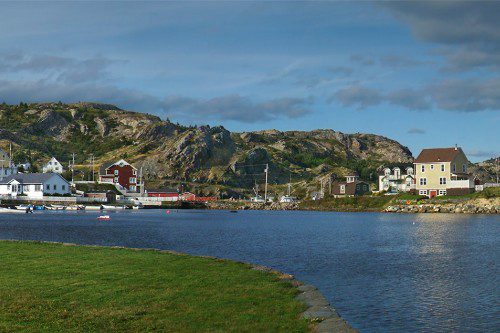
→ “Missed Blueberry” is a real pageant. Cousin Brigus (Newfoundland and Labrador) wrote from the 36th Brigus Blueberry Festival — a folk festival, a pie-eating contest, screech-ins, a parade, and fireworks over the outport. The pageant is tongue-in-cheek. The blueberries are not.
The town of the world’s largest kubasa fires up the grill.
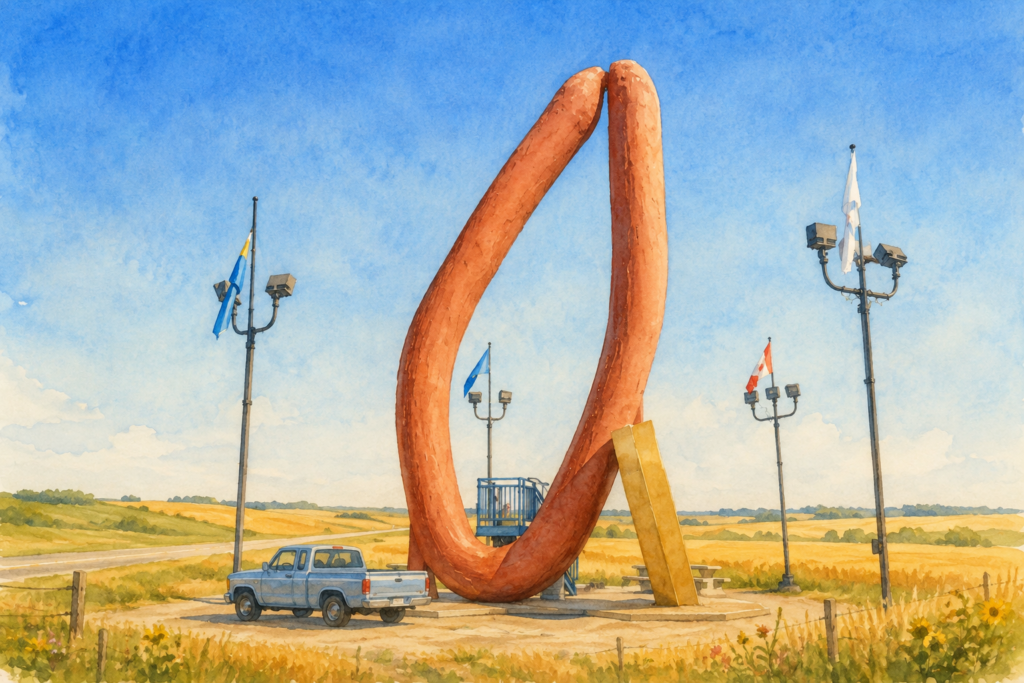
The Stawnichy family has been smoking sausage in Mundare, Alberta, since 1959. Three generations of it. This month, they fire the grills again for the town’s annual Agri-Days — held on the third weekend of August, with a parade, a firehall pancake breakfast, a show-and-shine, a street market, and fireworks over the wheat fields.
The town’s centrepiece is a forty-two-foot fibreglass sausage beside the highway. Built in 2001. Officially the world’s largest kubasa.
You met Cousin Mundare in Letter #14 — perogies on the table, polka music in the community hall. This month she writes with smoke coming through her open kitchen window.
Cousin Mundare says the giant kubasa is the only reason her town has ever appeared on a British game show.
Last week I wrote to you about the first Monday of August — the holiday with too many names. Somewhere in that letter, from Gimli, I told you that out in Kaslo, British Columbia, they were spending BC Day at the Kaslo Jazz Etc. Festival — jazz quartets tuning up on a stage that floats on Kootenay Lake.
Nikko Snyder, of the Valley Voice in the Kootenays, wrote to me the same morning the letter went out.
The Kaslo Jazz Etc. Festival had not happened this year. After more than thirty summers — the floating stage, the mountains, the music carried out across the water — the Society had called off its 2026 season. Years of rising costs. A hard run of wildfire summers. Lost sponsorship. A debt that reached a quarter of a million dollars. This August, for the first time in a long time, the stage stayed on shore.
I had written otherwise.
We have corrected the letter on the website.
I check every fact in every letter. I missed this one. I’m sorry.
But Nikko didn’t only write to correct me. She wrote to ask a favour — the good kind.
The Kaslo Jazz Etc. Society is not letting the festival go. The board has quietly paid down most of that debt. Now they are raising what’s left to bring the music back to the Bay in the summer of 2027. Neighbours have been turning out all season to help.
So here is the favour, passed along. If you have ever stood on that shore, or meant to, the Society is raising funds to bring it back: kaslojazzfest.com.
A festival is a strange thing to grieve and a fine thing to save.
It is only music on a floating stage. It is also a small town’s proof that it can still gather.
Thank you, Nikko. And thank you to everyone in Kaslo who is not done.
— Castor
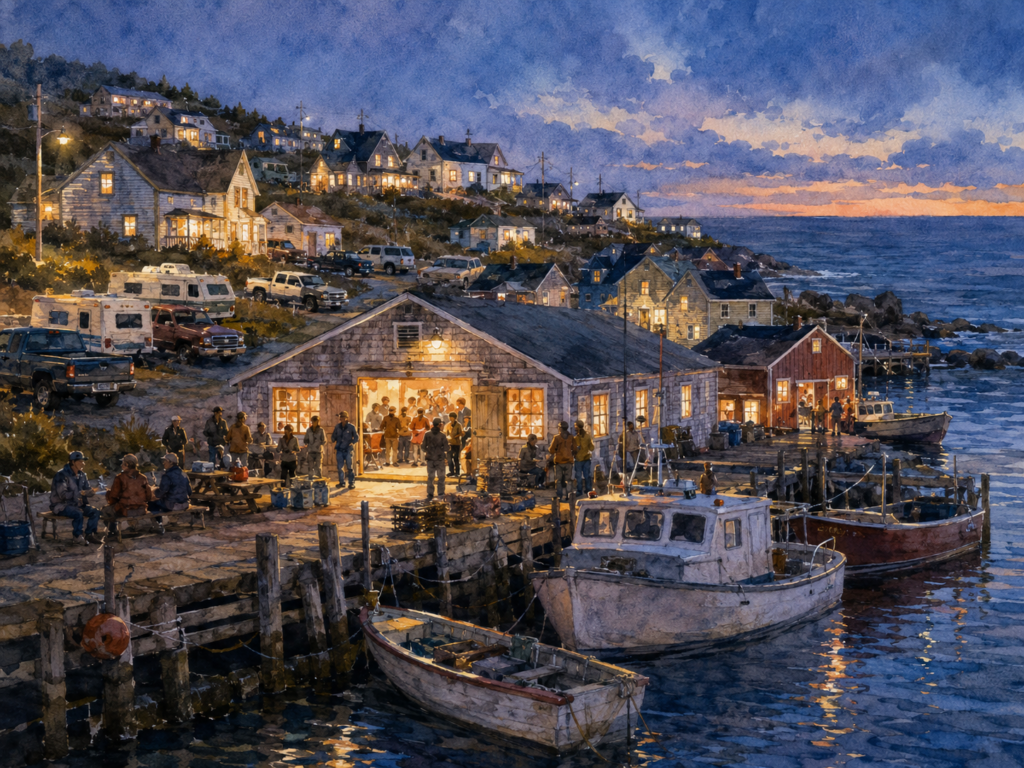
Every few years, an outport calls its scattered family home for a week. The diaspora — the ones who left for Fort McMurray, Toronto, Halifax, Alberta oil patches, Ontario factory towns — comes back at once.
This week, that town is Englee. Six hundred people live there. Twelve hundred are there right now.
Englee sits at the end of the road on Newfoundland’s Northern Peninsula — literally the end. The highway just stops at the ocean’s edge. For most of the year, six hundred souls, the North Atlantic winds, the lights on against the dark.
Then the call went out.
They came back this week in pickup trucks driven five thousand kilometres from Fort McMurray. In planes from Toronto. On ferries across the Gulf of St. Lawrence.
August 2 to 9 this year. Every dark house on Frederick Street opens up. Camper vans in every driveway. The Anchor Pub busy from noon till midnight. The kitchen parties spill into sheds. Toutons with molasses on the breakfast table. Fish fries. Cod tongue dinners. The Screech-In — you kiss a cod, you take a shot of Newfoundland Screech rum, and by the end of it you are a Newfoundlander in good standing again.
For eight days, a town that the statistics say is shrinking becomes the loudest and most densely populated place on the island.
They are not just visiting a hometown. They are proving that a community isn’t defined by a boundary on a map. It is defined by the distance its people are willing to travel to sing together again.
Grandfather Henri would have called this the truest kind of citizenship. Not the one on your passport. The one that pulls you thousands of kilometres for a shed dance.
Last week’s puzzle: Which New Brunswick island reachable only by ferry sits inside the world’s highest tides, harvests the world’s most prized dulse, and served as an American novelist’s summer refuge?
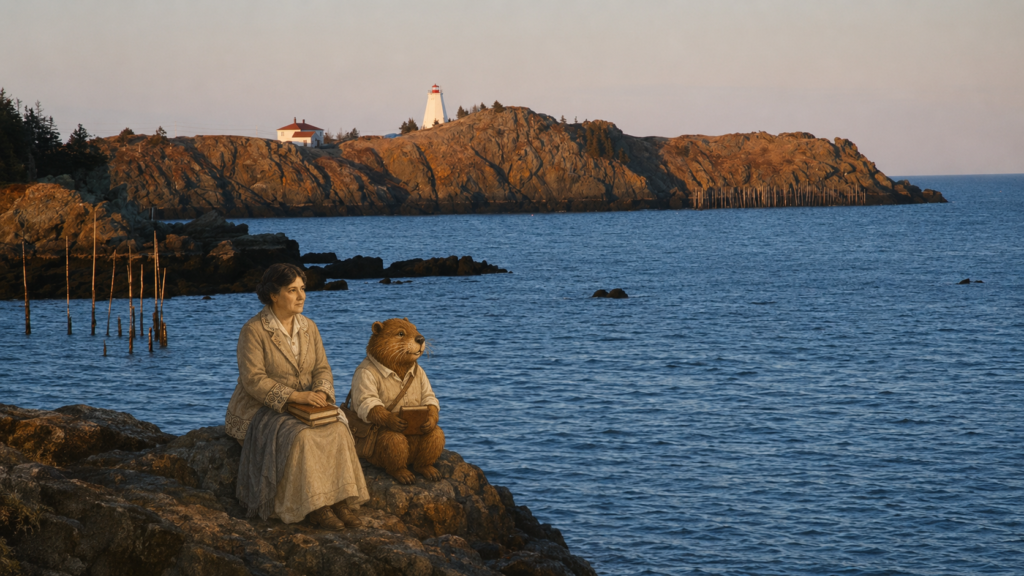
Answer: Grand Manan Island, New Brunswick. The novelist was Willa Cather, who spent her summers at Whale Cove between 1922 and 1940. Some of her most important work was written on that island.
✦ ✦ ✦
No new puzzle this week. Instead, an update from a town we’ve told you about before.
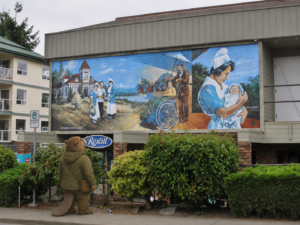 We wrote about Chemainus, British Columbia a couple of weeks ago, in Letter #13 — the Vancouver Island mill town that saved itself from economic collapse after 1981 by covering its walls in paint. Forty years later, Chemainus has more than sixty murals and ten sculptures. It is a globally copied model of arts-led town revival.
This month, the town unveiled a new mural. It faces a harder chapter.
The mural addresses the region’s Japanese-Canadian legacy — and the history of wartime internment that emptied Vancouver Island of its Japanese-Canadian residents in 1942. Fishermen, farmers, shopkeepers, and children were taken from Chemainus and towns like it and sent to camps in the interior of British Columbia and the Prairies. Very few returned.
The town that painted its way out of one crisis is now using its walls to face another.
Cousin Chemainus says the paint is a way of writing the town’s whole story on the town’s whole surface. Both the parts they built. And the parts they lost.
✦ ✦ ✦
I’ll try to make it to White River this week. Winnie’s Hometown Festival runs Thursday to Sunday, and I have been meaning to shake a paw with that bear since I was a kit.
I’ll write next week from somewhere else. Got a town in mind? Write to me. I’ll ask the cousin there. – Yours in maple,

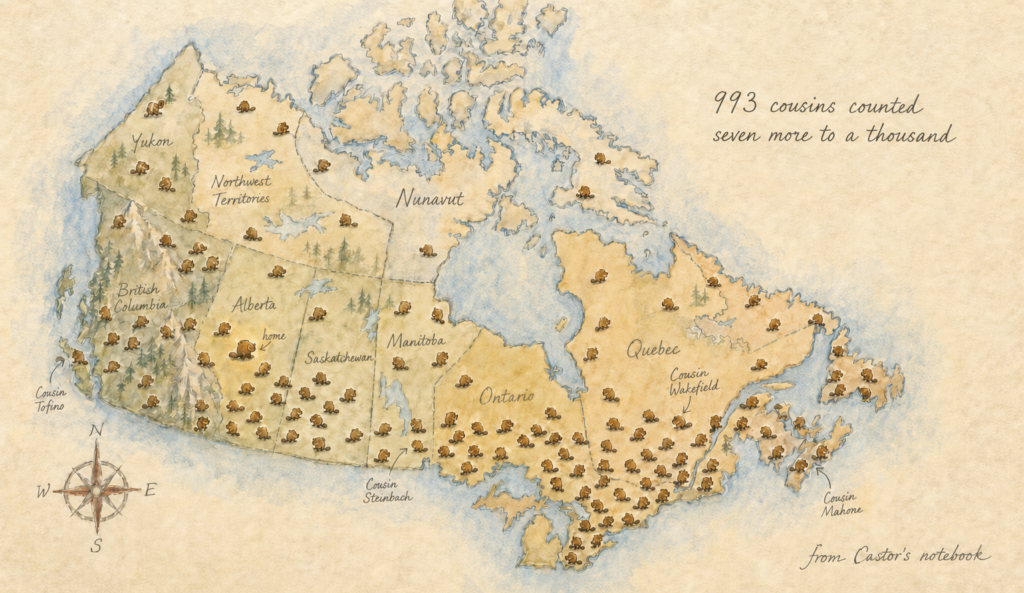
P.S. 993 cousins counted. Seven more to a thousand.
P.P.S. We added a new town to our 1000towns map – Ogema, Saskatchewan
More from the road this week
Castor, Alberta — population 876, where the streams east of Red Deer kept the family in dam-builders for generations.